Backgammon-type games began in the ancient Middle East. The oldest known boards come from Mesopotamia and Persia and are about 4,500 to 5,000 years old. Backgammon in Turkey became widespread in Ottoman times, and the legend below is the Persian story of its inventor.
Add Tours Around Turkey as a preferred source on Google
Backgammon, which was invented around 1400 years ago by Büzur Mehir who was the vizier of the Iranian shah Nevshiyan. Drawings on the backgammon represent units of time. 6 reciprocal digits represent 12 months, 15 stamps in two different colors each represent 15 nights and 15 days in a month, and 12 reciprocal digits represent 24 hours of the day. The 4 corners of the backgammon represent all four seasons.

Backgammon, which has developed over the years in different geographies and was played in different styles, became widespread in the Ottoman Empire in the 1400s. There are many varieties in the backgammon playing styles, which continue even today as it was played in the Ottoman Empire. What I mean by “modern backgammon”; It means the game of backgammon in which the cup is used for throwing dice to prevent the dice tricks. There is no difference in rules between the modern and the classic game.

There is a story about the game of chess and backgammon coming from ancient times. When the Indian Emperor sent a chess game to the Persian Emperor as a gift, the gift contained the following inscription:
Who thinks more knows better
Whoever sees further wins
That’s how life is…
Indian emperor

Indian emperor sent this message to the Persian Emperor. So the Persian Emperor told his vizier to invent a game to present to the Indian Emperor in return for this gift. This is how the game of backgammon emerged, and the Indian Emperor found the following message in the gift:
Yeah, who thinks more knows better
Whoever sees further wins but it’s also a bit of luck
That’s what life is…
persian emperor

Known as the most played board game of all time, backgammon is popular among tradesmen in our country Turkey. Tournaments are organized between cities, universities, professional groups, and friend groups. Large-scale backgammon tournaments are also held around the world.
Turkey was included in the World Backgammon Federation, which was established in 1986, in 2000. The aim of the federation is to ensure that backgammon is accepted as a game of intelligence and strategy, rather than being a game of chance, by combining the game rules, which are played with different names in many countries in the world and actually show minor variations, under certain standards.
Where Was Backgammon Invented?
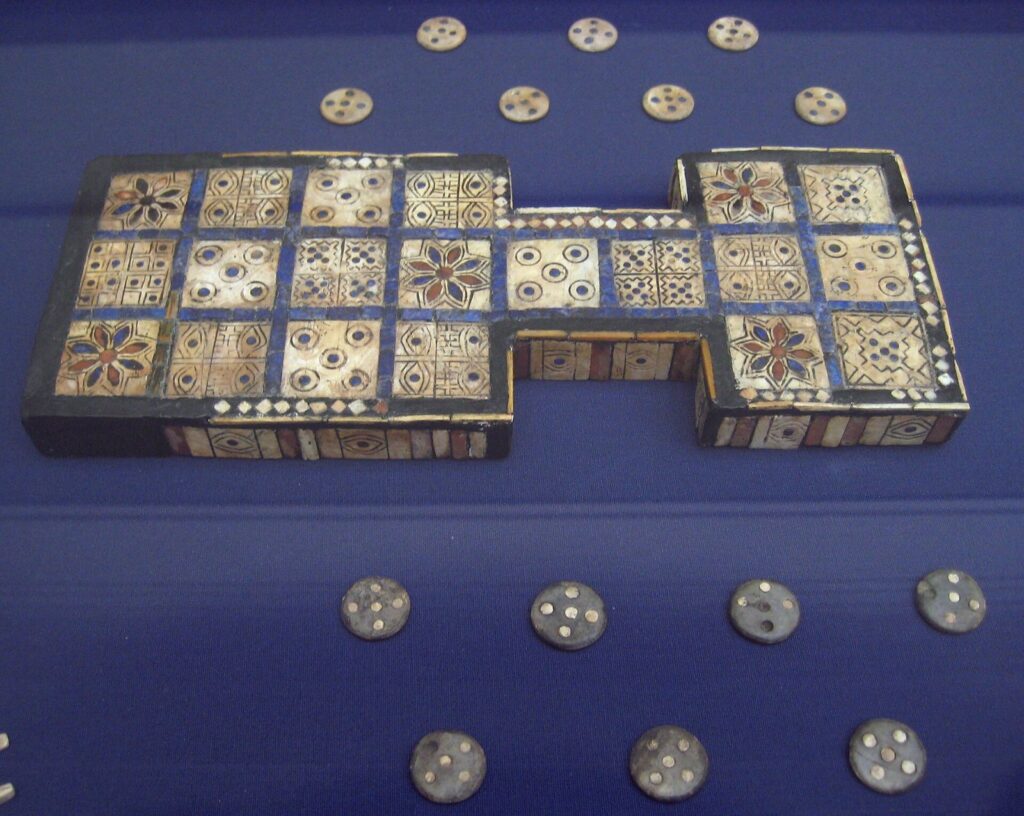
Nobody knows the exact place, but the earliest evidence comes from ancient Mesopotamia and Persia. A game set from the Burnt City in Iran, with an ebony board, two dice and 60 pieces, seems to date to about 3000 BC. The Royal Game of Ur is around 4,600 years old. Both are probably ancestors of the game, not the game itself.
Turkey has an old set too: the burials at Başur Höyük in Siirt, from about 3000 BC, held gaming pieces and dice.
When Was Backgammon Invented?
Nobody knows the exact year, the closer relatives of backgammon came much later: the Roman game of twelve lines, Byzantine tabula and Persian nard, dated between the 3rd and 6th centuries AD. The Büzur Mehir story belongs to nard, since one Persian tradition places its invention in the 500s AD, under King Khosrow I.
Tavla, the Turkish Backgammon
Tavla comes from the Latin word tabula, a board. The traditional Turkish game has no doubling cube, and a normal win counts one point and a gammon two. In Ottoman coffeehouses people played chess and backgammon, and in kahvehane today the checkers still click beside glasses of Turkish tea.
Frequently Asked Questions
Is backgammon Turkish?
Not originally. The tables games began in the ancient Middle East. Tavla became widespread in Ottoman times and is now part of everyday life in Turkey.
What are the dice names in Turkish tavla?
Players name the numbers with Persian words: yek is one, dü is two, penç is five and şeş is six. A double six is düşeş, and a six and a five is şeş beş.
How do you play Turkish backgammon?
Each player has 15 checkers and moves them around 24 points by rolling two dice, in opposite directions. The first to bring all checkers home and take them off the board wins.

Play Backgammon in Turkey
I love to play backgammon during my free time during my tours. You can always find backgammon laying somewhere in Turkey. I will be happy to challenge you for a game of backgammon when you visit Turkey. You don’t know how to play it? Don’t worry I will teach you. Contact me to hire a professional tour guide in Turkey and also you can learn some local traditions too! See you soon, Hasan Gülday.