Literacy in ancient times was never universal, and education was mostly a privilege. Boys from richer families learned reading, writing, arithmetic, music and sport, while most children learned farming or a craft from their parents. Big cities such as Ephesus had gymnasiums, like the East Gymnasium, and a famous library, the Library of Celsus.
Add Tours Around Turkey as a preferred source on Google
Literacy goes back thousands of years, but the popularity of literacy in the world is a very new phase. Thanks to the Industrial Revolution, the cheapening of paper and printing, and the fact that books became more accessible. The graffiti and signs found on the walls of some old Roman cities such as Pompeii show that the people were literate enough to be guided by signs but still some favored road signs made into symbols such as in Ephesus.
Who Went to School in Ancient Times?
For most non-elite free citizens, education began with the father. Children learned trades such as agriculture or crafts such as masonry or pottery from their fathers. In many parts of Anatolia, agriculture had always been seen as a family occupation and tradition to be passed to the next generation. School education compared to vocational-based family education appeared as a more social and city-wide organization in the Ancient Period.
Education was a luxury. In the Ancient World, children had to come from wealthy families to receive education such as reading, writing, and arithmetic. In ancient Anatolia, basic education was free for everyone coming from high-class families of the city, but you still had to pay to take courses in rhetoric and philosophy.

Citizens of the ancient cities such as Ephesus, Hierapolis, Pergamon, and many more attached great importance to education. Literacy became widespread thanks to the Greek alphabet, which reached an advanced level with the spread of education. Of course, only the Greek nobility could benefit from the educational service. The Greeks were influenced by the Phoenicians and developed the Greek alphabet. They added vowels to the consonant rich alphabet of the Phoenicians and formed the Greek alphabet. Latin also has the feature of being an alphabet derived from the Greek alphabet too.
First Schools in Ancient Greece
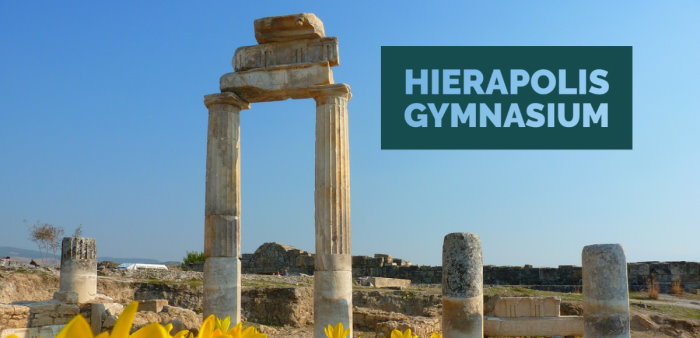
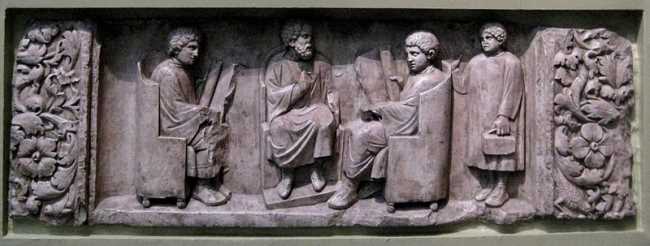
The first evidence for the existence of primary schools is mentioned in the tales of Herodotus. The first vase paintings depicting school life belong to the fifth century BC. On the vase, all three courses that should be included in education are pictured: literature, music, and sports.
Books, Libraries and Writing Materials
Books were often copied by the authors’ slaves and distributed by the authors. Books were generally circulated by the authors giving them to their relatives and acquaintances. The Greeks used a variety of materials for writing, from lead and wood to papyrus and parchment. The fact that papyrus is an expensive imported material has limited its use in daily life. Mostly wood-like mediums were used in schools and other daily works.
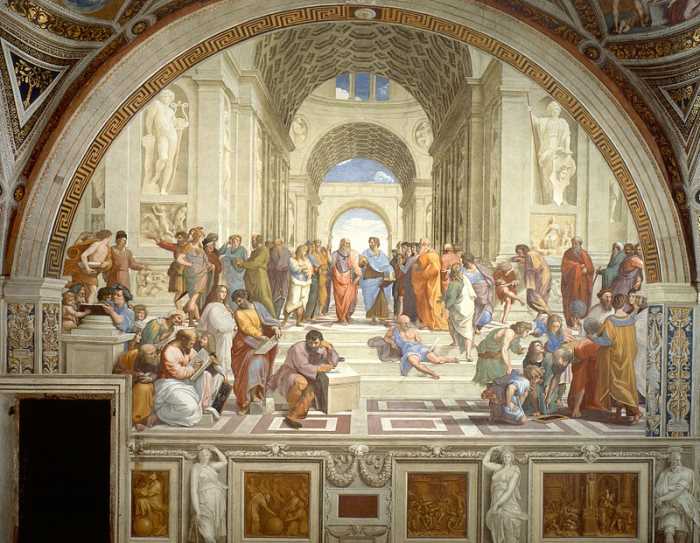
In the ancient world, librarianship started with the establishment of private libraries by tyrants and prominent political and cultural figures and reached its zenith with the libraries of Alexandria, Celsus Library of Ephesus, and Pergamon Library in the Hellenistic Period. These libraries did not only house books but also offices, study spaces, schools, etc. around them. Libraries of the ancient world functioned as cultural centers. Their directors were chosen from the leading writers, philosophers, and politicians of the period. As we know, public libraries actually became widespread during the Hellenistic Period.
Papyrus was a well-known product in these times, but it was very expensive to use. Papyrus was obtained by hand from the plant of the same name. The papyrus plant was mainly grown in the Nile delta of Ancient Egypt. Production was completely monopolized by the Egyptian Pharaohs. Besides being valuable, it is an extremely durable material when stored in a dry place. The famous physician Galen spoke about reading three centuries-old papyrus scrolls. Even the Pergamonites (People of Pergamon city) discovered parchment made from animal skin. Parchment was a harder and stronger material than Papyrus, but it was more difficult to write. As a matter of fact, it surpassed papyrus in later use.
Frequently Asked Questions
Were there schools in ancient times?
Yes, but not for everyone. In Greek and Roman cities teachers ran small schools, and fathers decided how long a boy studied. Roman school could meet in a house, in a gymnasium or even in the street.
Could ordinary people read and write in ancient times?
Only a minority could read well, and fewer could write long texts. Many knew just a few words, like names and numbers. Books were often read aloud to a group, so a listener did not need to read.
Did girls go to school in ancient times?
It depended on the city. Girls in Athens got no formal schooling, and their mothers taught them at home. In Rome, boys and girls were both educated, though not always together. Sparta even trained girls in sports under state supervision.