Every ancient city in Turkey has its temples, but some of them were built for a living man. The imperial cult in Asia Minor was the worship of the Roman emperor, often together with the goddess Roma and the imperial family, through temples, priests, festivals, games and sacrifices. It began at Pergamon in 29 BC, spread to Smyrna and Ephesus, and shaped the world in which the Book of Revelation was written.
Add Tours Around Turkey as a preferred source on Google
To understand the seven letters of Revelation, we cannot read them only as religious literature. We also have to understand the political pressure under which they were written. Apart from the Jewish question, the commercial interests of each city and the arguments about Balaam and Jezebel, there was one great force behind every letter, and text rarely names it directly.
The imperial cult is something I have been thinking about for years, both as a tour guide who walks people through Pergamon, Ephesus and Smyrna, and as a Turkish citizen who has lived all his life in this part of world. Let’s have a look at what it was, where it came from and how it pressed on the small Christian communities of the seven cities.
What Was the Imperial Cult
The Roman imperial cult was a form of worship inside the Roman state religion. It honored the emperor, sometimes together with the goddess Roma or members of his family. There were temples to the emperor, priests of the emperor, festivals and games in his honor and public sacrifices. People also swore oaths on the emperor’s genius or on his fortune.
In modern Western thought this is a strange idea, because we separate religion and politics. In the ancient Roman world the civic and the sacred were the same thing. To take part in the life of a Greek city under Roman rule was to take part in its rituals, from the city calendar to the games in the stadium. Refusing looked like refusing to be a normal citizen, and sometimes like disloyalty to Rome itself.
Origin of the Imperial Cult in Asia Minor
The imperial cult did not start with the Romans. The Greek kings after Alexander the Great, like the Ptolemies of Egypt and the Seleucids, claimed divine status, although the Attalid kings of Pergamon were not called gods before their deaths. When Rome came to the East, the Greek cities honored the new power in the same way and created a goddess called Roma. Smyrna later claimed to have built the first temple to Rome, in 195 BC.
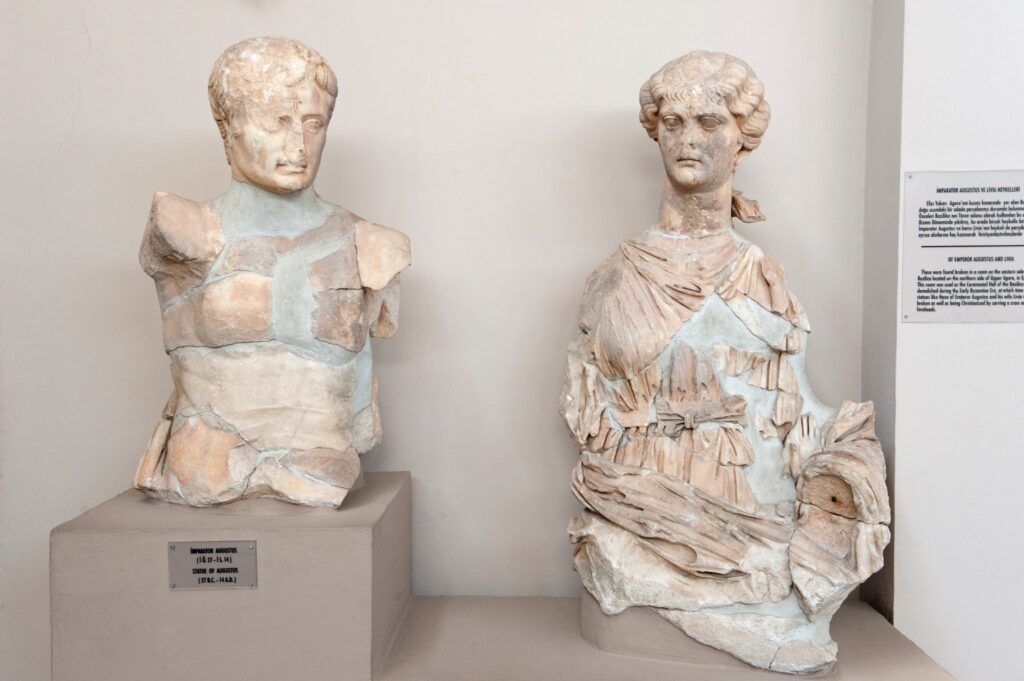
Julius Caesar was murdered in 44 BC, and in 42 BC he was officially declared a god of the Roman state, Divus Iulius. His heir Octavian, the later Emperor Augustus, was more careful, in Rome itself he refused temples. In the provinces, as the historian Suetonius writes, he accepted a temple only in his own name together with Rome.
In 29 BC the provincial council of Asia received permission to build a temple at Pergamon to Roma and to Octavian, who took the name Augustus two years later. It was the first provincial imperial temple in the province of Asia. At the same time, Roman citizens living in Ephesus were allowed to worship Roma and the Divine Julius, but not the living ruler.
By the way, one of the clearest voices of this cult comes from Priene, south of Kuşadası. In 9 BC the province of Asia decided that its year would begin on Augustus’ birthday. The decree found at Priene calls the birth of Augustus the beginning of good news, euangelion in Greek. It is the same word Christians later used for the Gospel.
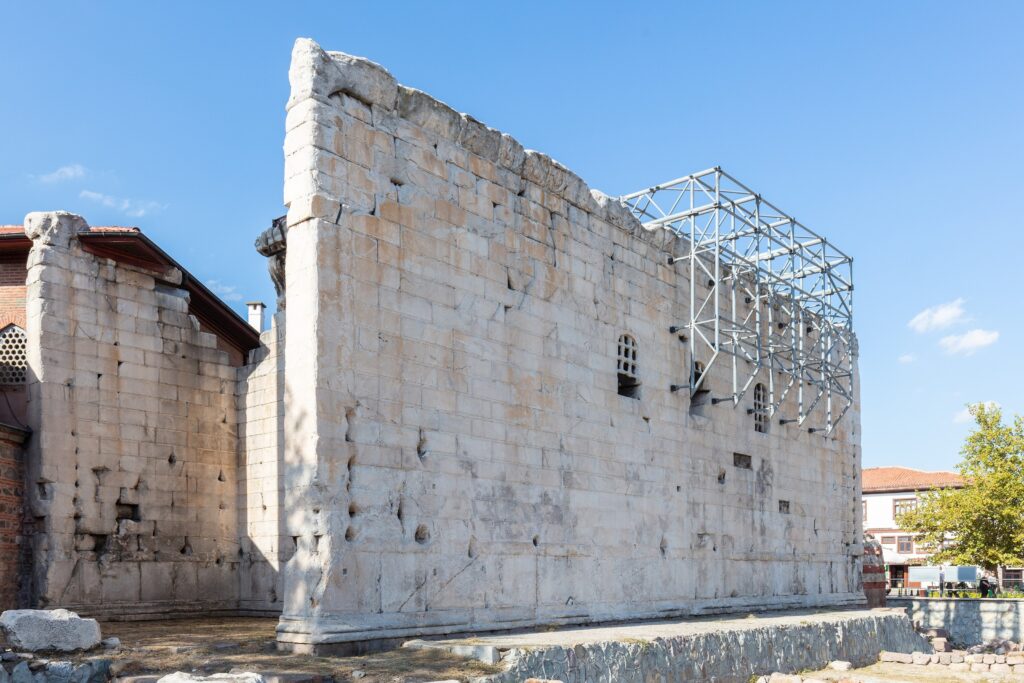
A temple of Augustus and Rome still stands in Ankara, the capital of the Roman province of Galatia. It was built around 25 to 20 BC. On its walls is the most complete surviving copy of the Res Gestae, the account of his own deeds that Augustus left behind, in Latin and in Greek.
Imperial Temples and the Neokoros Title
Other cities wanted the same honor. In 23 AD the cities of Asia voted a temple to Emperor Tiberius, his mother Livia and the Roman Senate. Eleven cities competed for it. Tacitus tells how their envoys argued in front of Senate in Rome, and in 26 AD Smyrna won, with Sardis as its last rival. Smyrna reminded the senators of its old temple to Rome.
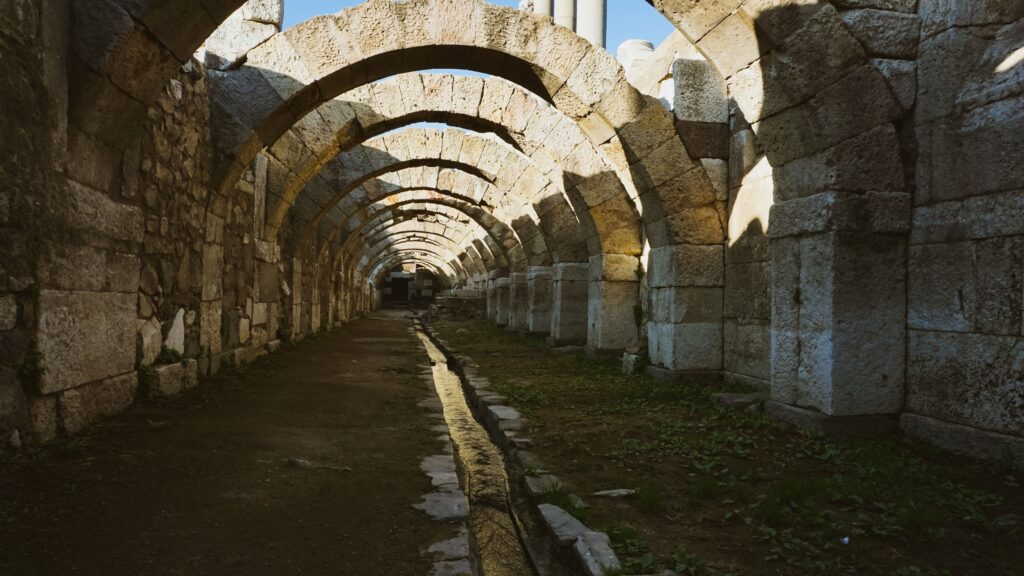
Ephesus had to wait for the Flavian emperors. Under Domitian, in 89 or 90 AD, a great temple was dedicated in Ephesus to the Sebastoi, the “revered ones”, meaning the Flavian imperial family. It stood on huge vaulted terrace in the upper city. You can read more in my article on the Temple of Domitian in Ephesus.
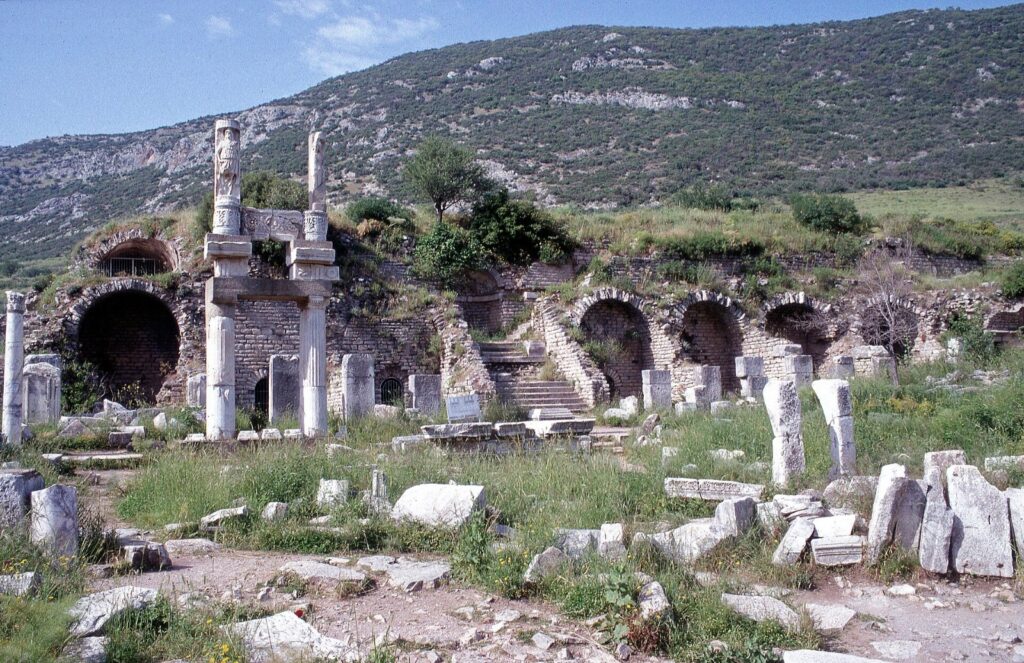
With this temple Ephesus became neokoros, which means “temple warden”, literally “temple sweeper”. The Roman Senate gave this title, with the emperor’s consent, to a city whose imperial temple served the whole province. According to the scholar Steven Friesen, Ephesus was the first city to be named neokoros in this sense, thanks to the Temple of the Sebastoi.
Bible knows the word too. In Acts 19:35, the town clerk calms the crowd in the theater of Ephesus by saying that the city is the neokoros of the great goddess Artemis. The King James Version translates it as “worshipper”. In Paul’s day the title belonged to Artemis, and a few decades later it belonged to the emperors as well.
The race went on. Under Emperor Trajan, in 113/114 AD, Pergamon became the first city of the province to hold a second neokoros title. It was for the Trajaneum on the top of its acropolis, a temple shared by Trajan and Zeus Philios. Fragments of statues of Trajan and Hadrian were found in its ruins.
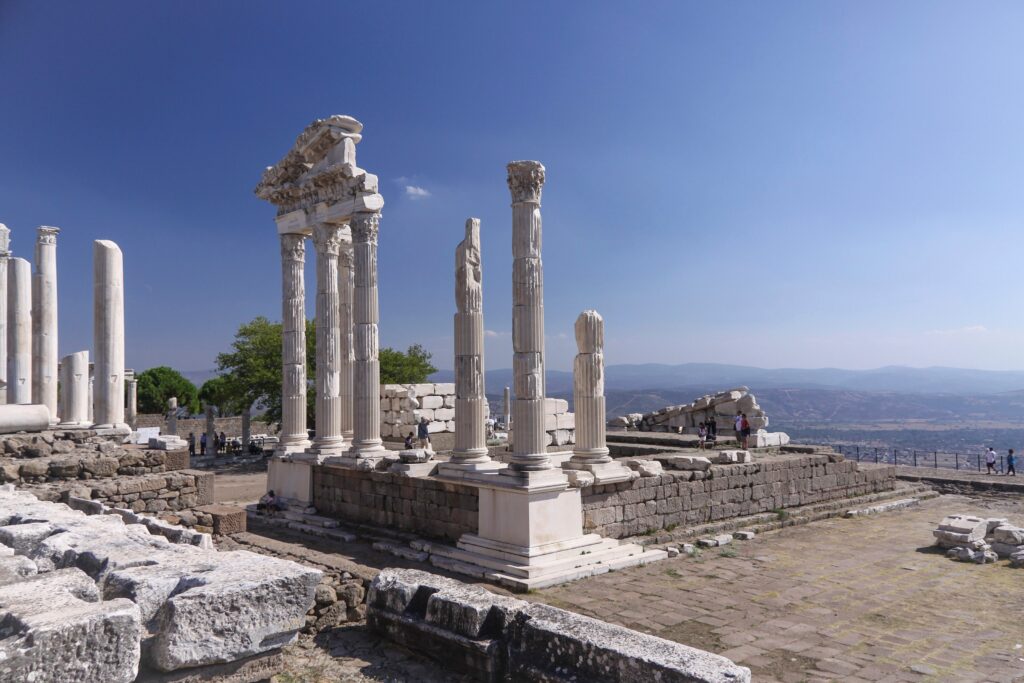
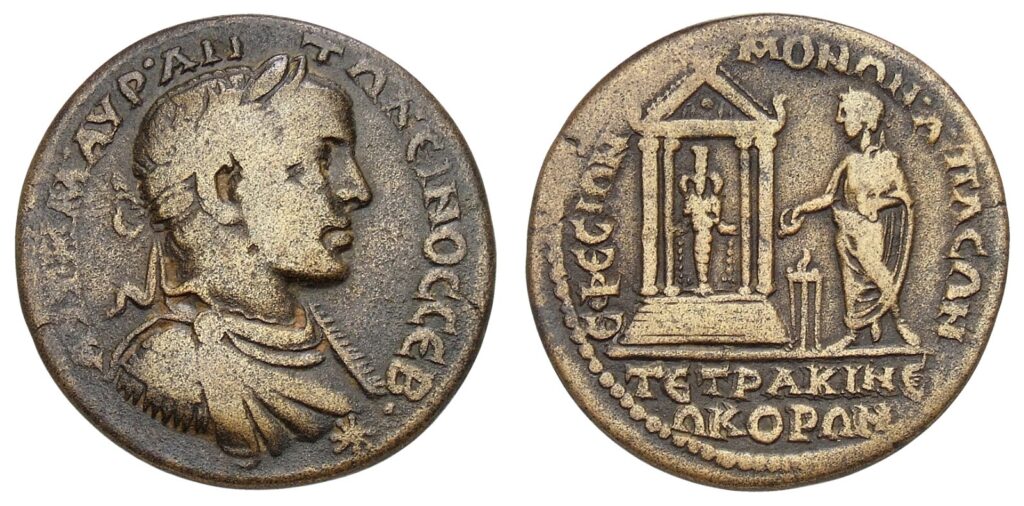
Ephesus answered with a second title, for a temple of Hadrian. Cities counted these titles with a great pride and put them on their coins and inscriptions. In the early 3rd century Ephesus received a third temple, to Emperor Caracalla, and later its coins even called it “four times neokoros”, a record no other city matched. Its old rival Sardis held two titles.
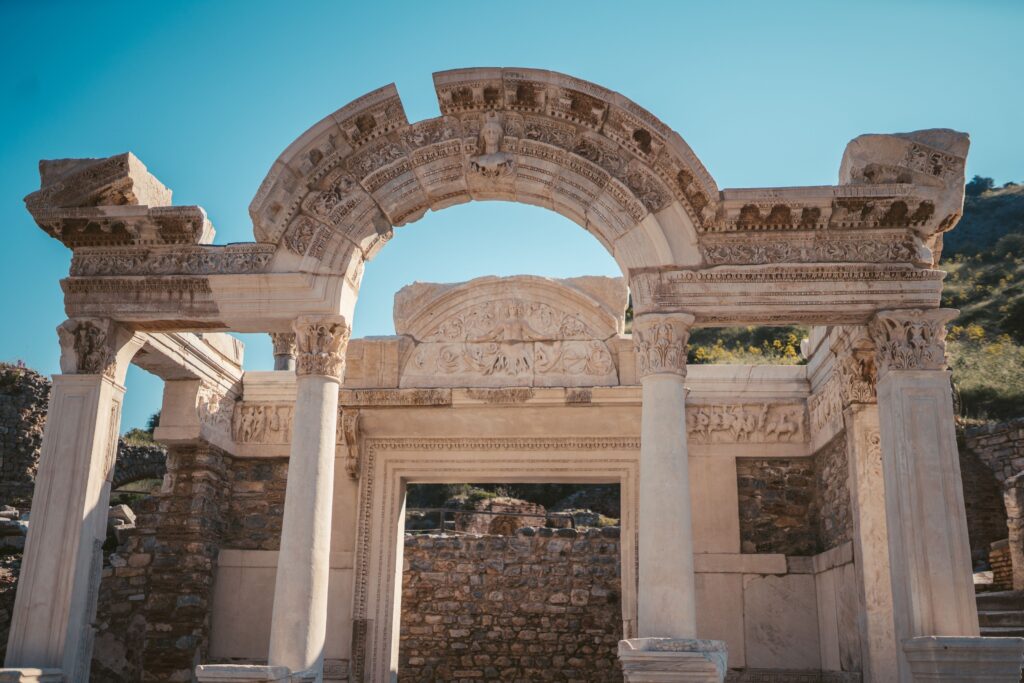
Please keep it in mind that the beautiful Temple of Hadrian on Curetes Street is not that provincial temple. Its inscription says that a rich citizen, Publius Quintilius Valens Varius, built it around 117 or 118 AD for Artemis of Ephesus, Emperor Hadrian and the people of Ephesus. Private citizens also joined the imperial cult with their own money too. Here is my guide to the Temple of Hadrian in Ephesus.
Asiarchs and the Provincial Council
The cult was run in two levels. At the provincial level there was the koinon, the assembly of the cities of Asia, with its high priests of the imperial cult. The Asiarchs were leading men of the province, elected by their cities and confirmed by the Roman proconsul. They presided over the assembly and paid for games in honor of the gods and the emperors.
Most scholars think that Asiarch and high priest of Asia were two names for the same office but some disagree. The Bible mentions them in Acts 19:31. During the riot of the silversmiths in Ephesus, “certain of the chief of Asia, which were his friends” begged Apostle Paul not to go into the Great Theater.
So men whose office was tied to emperor worship were friends of Paul. Each city also had its own imperial priests, altars and festivals. Some sixty years after Revelation, an Asiarch named Philip was in the stadium of Smyrna when the crowd asked from him to set a lion on the old bishop Polycarp. He refused, saying the animal shows were over.
Domitian and the Imperial Cult
Most scholars date the Book of Revelation to around 95 AD, near the end of the reign of Domitian. Domitian, the younger son of Vespasian, became emperor in 81 AD. He revived the imperial cult, which had grown quieter under his father, and his first act as emperor was to make his dead brother Titus a god.
The Roman historian Suetonius writes that Domitian once began a circular letter, issued in the name of his procurators, with the words “Our Master and our God bids that this be done.” After that, says Suetonius, people addressed him in no other way. In Latin the phrase is dominus et deus, “Lord and God”. You can read Suetonius’ Life of Domitian online.
For Christians this phrase had a sharp edge. In the Gospel of John (20:28), Apostle Thomas sees the risen Christ and says, “My Lord and my God.” To give the same title to an emperor was, for a believer, to give Caesar what belonged to Christ. In Smyrna, Polycarp would later be asked, “What harm is there in saying, Lord Caesar?”
However, here I have to be honest with you. Many modern historians doubt the old picture. Domitian never put “Lord and God” on his coins or in official documents and there are reports that he even refused the title “Lord”. Historians such as Brian Jones think flatterers and his own officials used the phrase. Suetonius wrote some twenty-five years after Domitian’s murder, inside a senatorial tradition that hated him.
The same is true for persecution. Christian writers of the 4th century, like Eusebius, describe a persecution at the end of Domitian’s reign. Yet no author of his own time gives details of trials of Christians, and many historians now think there was no empire-wide campaign against them. The pressure was real but local, driven by neighbors and city officials as much as by Rome.
So Revelation does not need an emperor who personally demanded worship from every Christian. In Asia the cult was pushed from below, by proud cities, rich priests and loyal neighbors. You can read more in my articles on Emperor Domitian and on Nerva and the Christians after Domitian.
How the Imperial Cult Pressure Worked
Let me give some practical examples from our ancient sources. None of them needed an order from the emperor. A city festival, a banquet or a court case was enough to put a Christian in front of the same question.
In Smyrna, police captain urged Polycarp to say “Lord Caesar” and to offer sacrifice, as if it were a small thing. In the stadium the Roman governor asked him again and again to swear by the fortune of Caesar. He refused, and he was burned in 155 or 156 AD. The story is told in the Martyrdom of Polycarp.
In Pergamon and Thyatira, the letters of Revelation warn against eating food sacrificed to idols (Revelation 2:14 and 2:20). Historians think that the banquets of city festivals and trade associations often included sacrifices to the gods, and in many places to the emperors too. Thyatira was a city of dyers and purple cloth traders, so for a Christian craftsman, staying away from such meals could cost business.
In Bithynia, about fifteen years after Revelation, the governor Pliny the Younger tested accused Christians with a simple ritual. They had to pray to the gods, offer incense and wine before the image of the emperor and curse Christ. Real Christians, he wrote to Emperor Trajan, could not be forced to do any of these things.
Refusing was always possible but expensive. You might lose your customers, your place among your fellow craftsmen, your good name in the city and sometimes your life. In Turkey we say “damlaya damlaya göl olur”, drop by drop a lake is formed. The imperial cult worked the same way: small acts of incense and oath, day after day, made a lake of public worship.
Satan’s Throne in Pergamon
The letter to Pergamon says, “I know thy works, and where thou dwellest, even where Satan’s seat is” (Revelation 2:13, KJV). The Greek word is thronos, a throne. What did John mean? The verse does not say, and readers have suggested several answers.
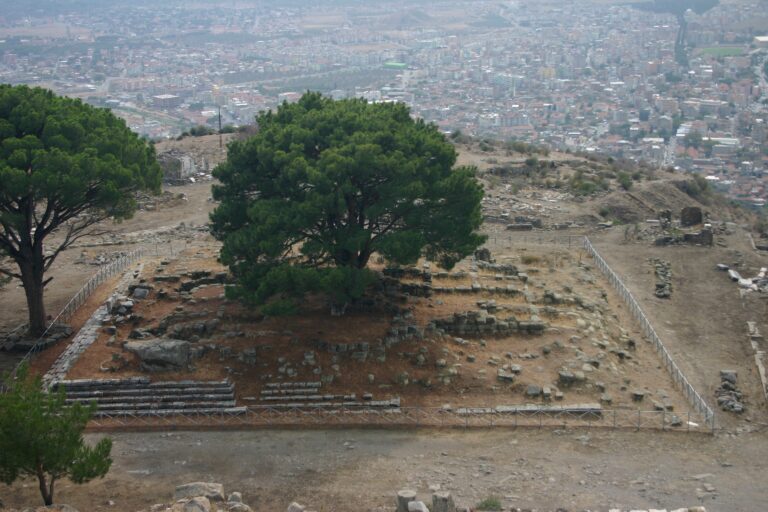
Many scholars point to the great Altar of Zeus on the acropolis, which looked like a giant throne. Its sculptures are in Berlin today, and only its foundation remains in Pergamon Ancient City. Others think of the imperial cult, because Pergamon had the first temple to Roma and Augustus in the province. Others point to Asclepius, healing god of Pergamon, whose symbol was the serpent.
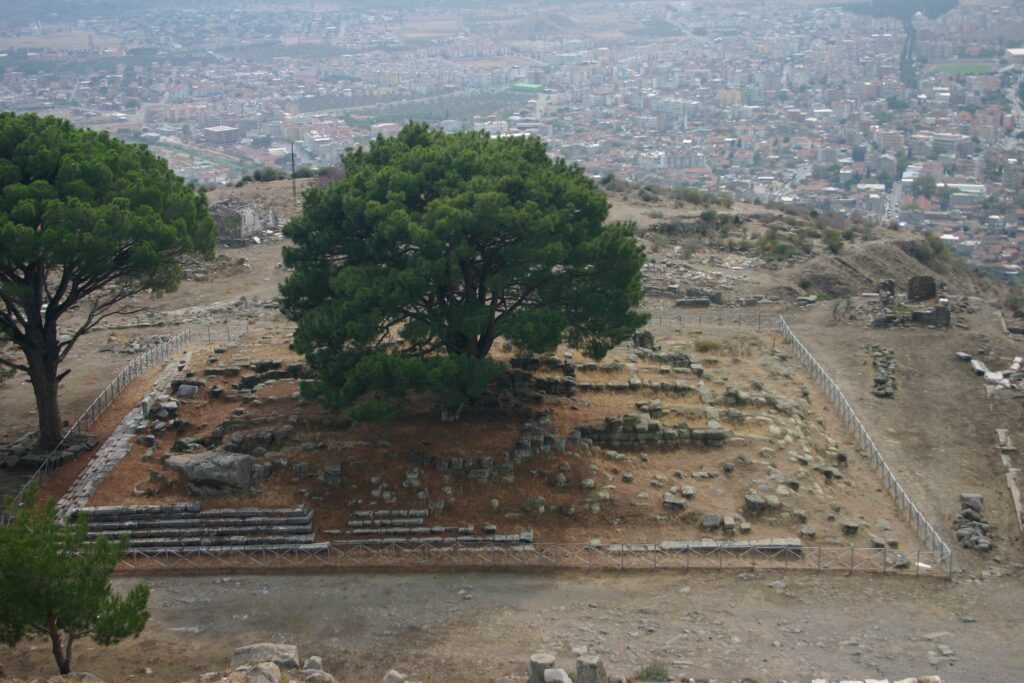
I tell my guests that these answers do not exclude each other. On the acropolis of Pergamon you see the altar terrace, the Trajaneum and the theater together. For a small Christian group, a whole city of gods and emperors could feel like the throne of Satan.
The same verse names Antipas, “my faithful martyr, who was slain among you”. He is the only Christian of the seven cities whom the Bible names as a martyr. The Bible does not say how or why he died, later tradition says he was burned in a bronze bull under Nero or Domitian. You can read more in my article on the martyrs and important figures of the Seven Churches.
The Christian Response to Emperor Worship
How did the early Christians respond? In a few different ways. Some, especially in the first generation, were too few for attracting official attention. They kept a low profile, met in their house churches, avoided the big festivals and were not noticed.
Some compromised. Revelation criticizes the followers of Balaam and the Nicolaitans in Pergamon and the prophetess it calls Jezebel in Thyatira, while it praises Ephesus for hating the works of the Nicolaitans (Revelation 2:6). These teachers seem to have argued that an idol is nothing and the meat is just meat. The seven letters reject this compromise.
Some endured punishment. After Antipas came Polycarp in Smyrna in 155 or 156 AD, Justin Martyr in Rome around 165 AD and the 48 martyrs of Lyon in 177 AD, many of them Greeks from Asia. The list grows through the next two centuries. You can read their stories in my article on the persecution of early Christians in Asia Minor.
And some wrote books. Revelation itself is, among other things, a book of resistance to the imperial cult. Its beast makes everyone receive a mark on the right hand or on the forehead (Revelation 13:16), and its woman sits on seven hills (17:9), a clear picture of Rome. Against all this it sets the Lamb who was slain as the true ruler.
Then comes the number of the beast, 666. Most modern scholars read it as the name “Nero Caesar” written in Hebrew letters, an idea that goes back to the 1830s. Some old manuscripts give 616, which fits the Latin spelling of the same name. Irenaeus already knew the 616 reading in the 2nd century, but he did not follow it.
End of the Imperial Cult
The struggle did not end with the seven letters. Persecution came and went for two more centuries. The real turning point came in 250 AD, when Emperor Decius ordered everyone in the empire to sacrifice to the Roman gods and for the emperor’s well-being in front of a magistrate, and to receive a signed certificate. Many of these certificates survive till today.
Diocletian began the last and greatest persecution in 303 AD. Galerius ended it in 311, and in 313 Constantine and Licinius agreed at Milan to give Christians legal protection. In 380 the Edict of Thessalonica, under Theodosius I, made Nicene Christianity the state religion of the Roman Empire.
Still, the imperial cult faded slowly. Constantine allowed a town in Italy to build a temple to his family, as long as no “contagious superstition”, usually read as sacrifice, polluted it. Dead emperors were called divus, divine, until the early 6th century. The emperor stayed sacred, but the incense and the blood were gone.
The deeper question has not gone away. What do you do when a political power asks for a kind of loyalty that conflicts with your faith? It comes back in different forms in every century. The seven letters, written around 95 AD to seven small communities under this pressure, remain one of the foundational answers to it.
Imperial Cult in Ephesus Today
Let me finish with one quiet image. When we enter Ephesus Ancient City from the Upper Gate, as most tours do, we soon reach the terrace of the Temple of the Sebastoi, just before Curetes Street begins to descend. Only the platform and its vaults survive, but they show you how big was the temple.
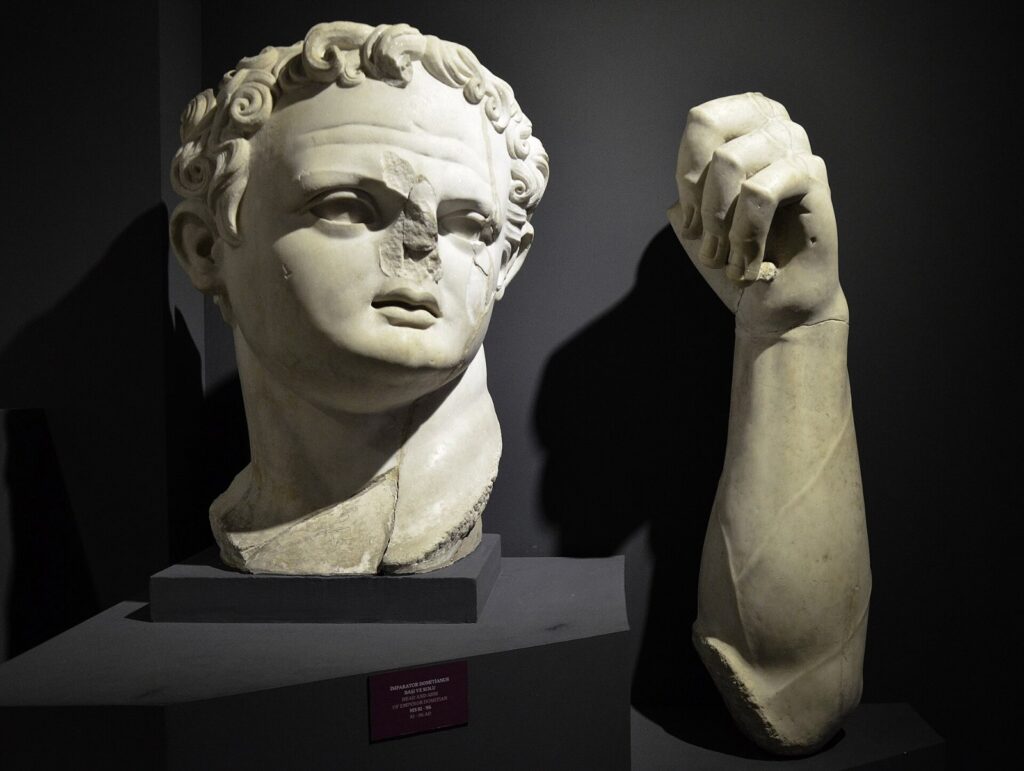
Then go to the Ephesus Museum in Selçuk, where a whole hall is given to the imperial cult. There you meet with the colossal marble head and forearm of the temple’s cult statue. The complete figure is estimated at about seven meters tall. It was long called Domitian, and newer research suggests it may show his brother Titus.
Stand infront of this stone head. Imagine the complete statue, and imagine a small Ephesian Christian walking through this public space in 95 AD, passing the great stone presence of the emperor-god every day. When do I bow? When do I look away? When do I refuse? These were the practical questions of the imperial cult.
The seven letters were written to people who had to answer them every day, in their own working lives. That is the political pressure behind every line of Revelation. Without it, the seven letters are mostly poetry. With it, they become something much sharper.
Frequently Asked Questions
What is the imperial cult?
The imperial cult was the worship of the Roman emperor, often together with the goddess Roma and the imperial family, through temples, priests, festivals, games and sacrifices. In Asia Minor it began with the temple of Roma and Augustus at Pergamon, permitted in 29 BC, and it soon became part of public life in every major city.
Who did the imperial cult worship?
In the eastern provinces living emperors were honored, usually together with the goddess Roma, and dead emperors declared gods by the Senate (divi) were worshipped across the empire. Family members could be included too, like Livia in Smyrna’s temple to Tiberius, or the whole Flavian family in the Temple of the Sebastoi in Ephesus.
What does dominus et deus mean?
Dominus et deus is Latin for “Lord and God”. Suetonius says that a letter issued in Domitian’s name began “Our Master and our God”. The title never appears on his coins or in his official documents, and many historians think flatterers and officials, not the emperor himself, made it common.
What does neokoros mean?
Neokoros means “temple warden”, literally “temple sweeper”. In the Roman period it became an honorary title for a city that held a provincial temple of the imperial cult. Ephesus received it for the Temple of the Sebastoi and later held it four times. In Acts 19:35 the city is called the neokoros of Artemis.
Hire Biblical Tour Guide in Turkey
I’m a nationally licensed Turkish tour guide based in Kuşadası, nearby Ephesus. My day guiding is in Ephesus, İzmir and Pamukkale, where Ephesus, Smyrna and Laodicea keep the story of the imperial cult and the early Christians in stone. My license is valid all over Turkey, so I can also join you as your personal guide on a longer journey through the Seven Churches of Revelation, Pergamon included.
You can see my guiding rates and guiding areas or write to me through my contact page.
I hope we will stand together one day on the terrace of the Temple of the Sebastoi and in front of that colossal head in the Ephesus Museum. You can always write to me with your questions about the imperial cult in Asia Minor, the Seven Churches or the early Christians of Asia Minor. See you soon, Hasan Gülday.