

The Phocaea ancient city lies under and around today’s Foça, a small seaside town about 70 kilometers northwest of İzmir. It was the northernmost city of Ionia, and its people were famous sailors who founded Massalia, today’s Marseille in France, around 600 BC.
Add Tours Around Turkey as a preferred source on Google
When Phocaea district emerged as an Ionian city in Antiquity, it was named Phokaia due to the seals living in the surrounding seas and this name came to this day as Phocaea. Seals are still the symbol of the city.

There are various opinions on the establishment of Phokaia; According to the ancient writer Pausanias, it was founded by people from Teos and Erthrai, in the west of Izmir. According to the ancient writers Herodotus, Strabo and Nikolaos of Damascus, the Phokis people living in the Peloponnesian Peninsula in Central Greece came to Anatolia and established Phokaia with the permission of the city of Kyme, which dominated the region.
The golden age of Phokaia ended with the capture of Sardes by Persians in 546 BC. Although the city had previously been surrounded by walls, according to Herodotus, the Persian commander Harpagos conquered these cities by piling earth mounds in front of the city walls. While Phokaia was besieged, most of the Phocaeans migrated to their colonies in the Mediterranean and later some of them went back.

After the death of Alexander, the Macedonian Empire was shared among its generals and new states emerged. Phocaea was ruled by the Seleucids, Attalos and the Kingdom of Pergamon. When the Kingdom of Pergamon was annexed to the Roman Empire in 133 BC, Phokaia was eventually conquered by the Romans. With the help of the colonial city Massalia, Pompeius gave the city its freedom. It became the episcopal center of the Byzantine Empire in the Early Christian Period. Phocaea became the Venetian Trade Colony in the early 11th century.
Who Were the Phocaeans?
The Phocaeans were among the first Greeks to sail far from home, reaching the Adriatic, Italy and Spain in fast ships with fifty oars. From there they founded Massalia, then Emporion in Spain and Elea in Italy.
What You Can See at Phocaea Today
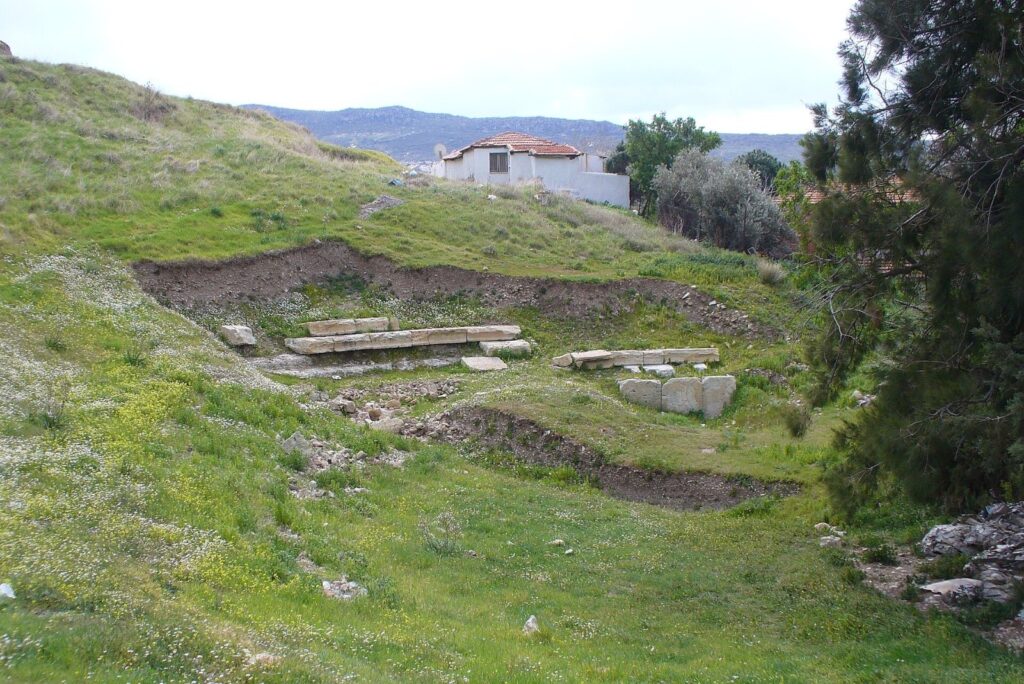
In and around Foça you can still see a theater, a rock-cut family tomb called the Devil’s Bath and the old castle walls. The theater dates to about 340 to 330 BC, which makes it one of the oldest in Anatolia.
The Devil’s Bath, Şeytan Hamamı in Turkish, is a family tomb cut into the rock in the 4th century BC, it has a long passage and two burial rooms.
The castle walls around the little peninsula carry repairs from Byzantine, Genoese and Ottoman times. Five Gates, called Beşkapılar, was boat house of the Ottoman fortress and was repaired in 1538 and 1539.
Monk Seals of Foça
Mediterranean monk seals still live along the coast of Foça, which has been a protected area since 1990. Only a small number live along Turkey’s coasts, and they are shy and rest in sea caves, so seeing one is rare.
Frequently Asked Questions
Who founded Marseille?
Greek settlers from Phocaea founded Marseille around 600 BC and called it Massalia. In ancient times it grew into the main trading city of the western Mediterranean.
Are there still monk seals in Foça?
Yes, a few. The Mediterranean monk seal is protected around Foça, but the seals are shy and live in sea caves, so most visitors never see one.
Can you visit the ruins of Phocaea?
Yes. The theater, the Devil’s Bath and the castle walls are in different parts of the town and its surroundings, so allow time to walk or drive between them.


1 comment