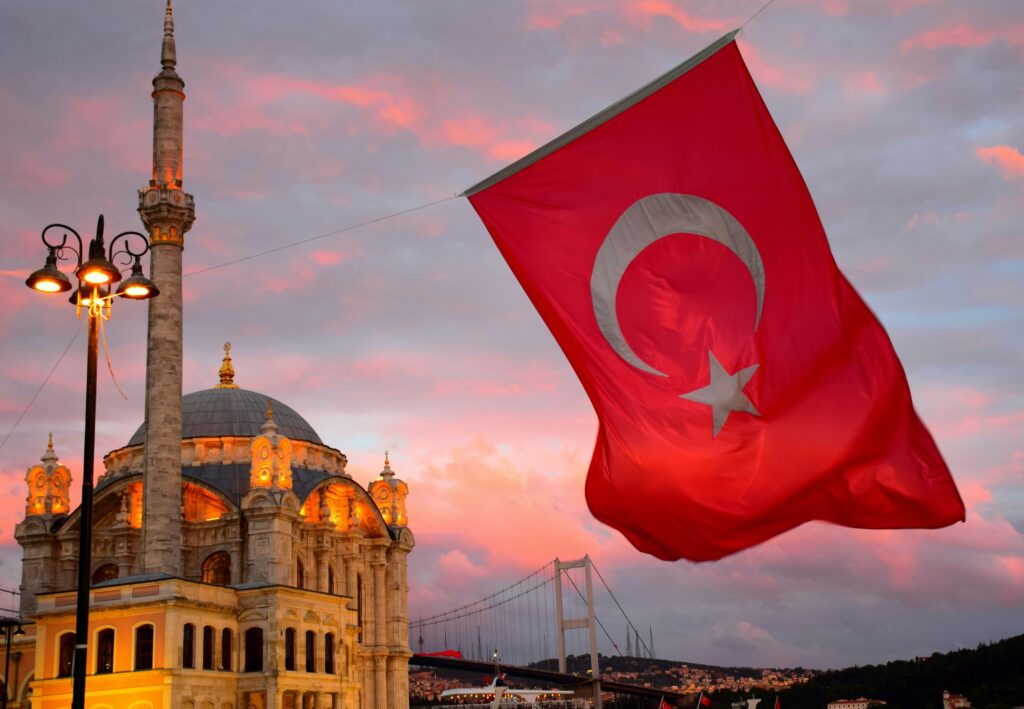
Turkish flag is one of the most beloved and devoted symbols in Turkish culture today. Turkish Republic of today inherited this design from earlier Ottoman Empire.
Add Tours Around Turkey as a preferred source on Google
The Turkish flag is a white crescent and star on a red field. The law does not explain its meaning, but red is commonly read as the blood of the fallen, and the crescent and star come with several legends. The design is the late Ottoman flag, with exact measures fixed by law.
| Colors | Red and white |
|---|---|
| Symbols | White crescent and five-pointed star |
| Local names | Al bayrak, “the red flag”, and ay yıldız, “moon star” |
| Law | Turkish Flag Law, first passed in 1936, now No. 2893 of 1983 |
Early Versions of the Turkish Flag

Red has always been the dominant color in Ottoman flags. I use the word flags because the Ottoman Empire of Medieval times was using more than one flag. There were many banners and seal which symbolized Ottoman sovereignty.
The Legend About Turkish Flag
The legend says that following the Battle of Kosovo in 1389, Sultan Murad saw the reflection of the Moon and a star on the blood puddles of the battlefield. He decided to turn this picture into a banner to remember fallen comrades. This early flag had an eight cornered star. The octagonal star was the symbol of victory.

Modern Turkish Flag
This early flag became the official flag of the Turkish Ottoman Empire during the reign of Sultan Selim the Third in 1789. There was an octagonal star on the Ottoman flag for about another century but later during the rule of Sultan Abdulmecid the octagonal star was replaced with a common five cornered star. This new symbol represents humanity.
Using crescent in Turkish culture goes even before the pre-Islamic era. Early Turks living in Central Asia believed in Shamanism and used crescent as an important symbol. We believe after the Islamisation of Turkish tribes, they kept the same symbol in the flag. Cresent is the common symbol in the Islamic world today.

Dimensions and colors of the Turkish flag are regulated by the Turkish Constitution’s article of flag law. Flags of Turkey cannot be humiliated, ripped, or littered by anyone. Also, the use of the Turkish flag by political parties or private institutions is not allowed.
What Does the Turkish Flag Mean?
There is no official answer, because flag law only describes the shape and the measures. The meanings come from the people. Many Turks read the red as the blood of the martyrs. For the crescent and star every person has a different answer, often freedom or Islam, and the star is the one nobody agrees on.
The legends above are stories, they are not documents, and there are other tellings too. The crescent was also an old symbol of Byzantium, the city we now call Istanbul.
The Turkish Flag Law
The first Turkish Flag Law came in 1936. It fixed the measures and the position of the crescent and star. Before that, the crescent and star could be a little slimmer or placed differently from one flag to another.
The law in force today is the Turkish Flag Law of 1983, and a regulation sets how flags are made.
Frequently Asked Questions
Does Turkey still use the Ottoman flag?
Not as the national flag. The Republic kept the last flag of the Ottoman sultans, a white crescent and star on red, and then fixed its exact shape by law.
Why is the Turkish flag red?
The flag law gives no reason. Red has long been a state color of Turkic and Ottoman rulers, and many Turks read it as the blood of the martyrs.
What are the proportions of the Turkish flag?
The flag is a rectangle with sides in the ratio 2 to 3, so the length is one and a half times the width. The law gives other measures as parts of the width.
Tour Guide in Turkey
Contact your Turkish tour guide to learn more about the Turkish flag. See you soon, Hasan Gülday.