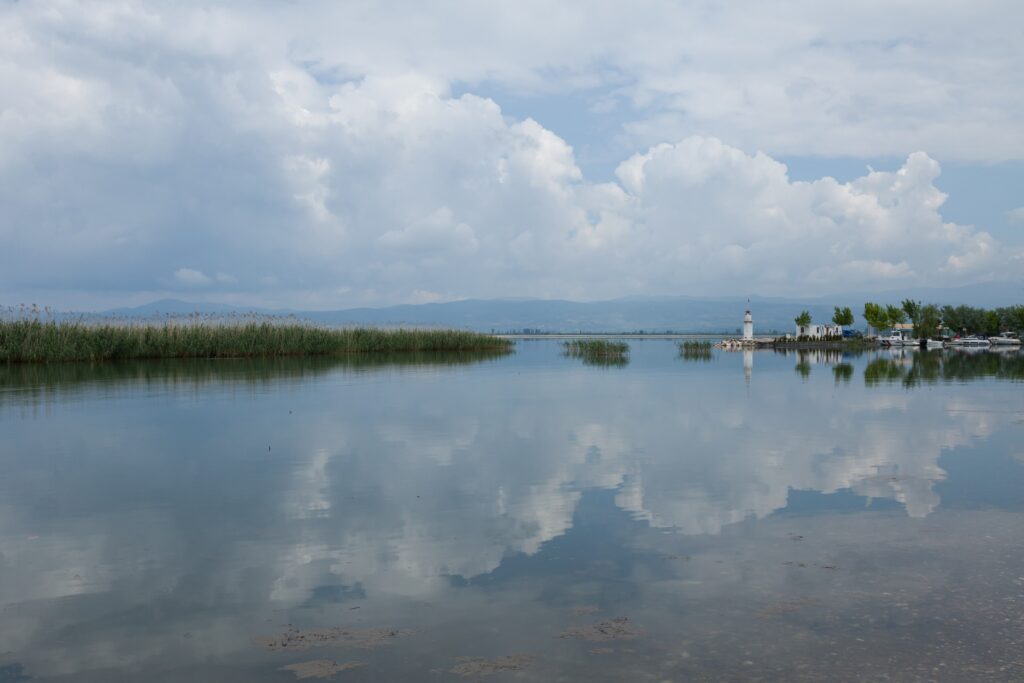
The Council of Nicaea met in 325 AD in Nicaea, today’s İznik in northwestern Turkey. It was the first ecumenical council, a meeting of bishops from across the Christian world, called by Emperor Constantine to settle the quarrel over Arius and the nature of Christ. It produced the first Nicene Creed, twenty canons and a rule for the date of Easter.
Add Tours Around Turkey as a preferred source on Google
In the late spring of 325, more than two hundred and fifty bishops traveled to a small town on a long lake in Bithynia, in my own country. They came from Spain, Egypt, Syria, Persia, Cappadocia, North Africa and Greece, by road and by boat. Some of them had survived the persecutions. Let’s have a look at those weeks in Nicaea, and at what you can still see in İznik today.
Why a Council Was Needed
The trouble began in Alexandria in Egypt. Scholars date the start of the dispute between 318 and 322. A presbyter named Arius taught that the Son of God was created by the Father, so that there was a time when the Son was not. His bishop, Alexander, taught that the Son was eternally born of the Father. For Arius only the Father was eternal.
Alexander called a local council of the bishops of Egypt and Libya, which sided with him. Arius refused to accept the decision and was excommunicated. He traveled through the East, wrote to many bishops and found supporters, above all Eusebius of Nicomedia and Eusebius of Caesarea. Soon the argument had spread through the churches of the eastern Roman Empire.
Constantine had agreed with his co-emperor Licinius in 313 to treat Christians benevolently, an agreement known as the Edict of Milan. In 324 he defeated Licinius and became the sole ruler of the empire. Then he heard about the quarrel in Alexandria. He wrote to Alexander and Arius that its cause was “trifling” and asked them to make peace.
Bishop Hosius of Cordoba carried the letter to Alexandria, but the two sides did not reconcile. A synod of eastern bishops at Antioch took the side of Alexander. So Constantine decided on something new, a general council of the bishops of the whole empire. The church had never held one before.
Why Nicaea
The bishops were first told to meet at Ancyra, today’s Ankara, in Galatia. Constantine moved the council to Nicaea in Bithynia. The town was close to his residence at Nicomedia, today’s İzmit, so he could attend in person, and it was easier to reach for bishops from every part of the empire. He also planned to celebrate the twentieth year of his reign there too.
Constantine paid for the travel of the bishops and for their daily needs. Eusebius says that some bishops used the public means of transport and others were given horses. For a church that had been persecuted only a few years earlier, this was a very different kind of welcome.
Nicaea was an old Hellenistic city. Antigonus refounded it as Antigoneia, and after 301 BC Lysimachus renamed it Nicaea, in tribute to his wife. It lies at eastern end of Lake İznik, with its western wall rising from the water. Under Rome it was important city of the province of Bithynia and Pontus. By the way, İznik is only the Turkish way of saying Nicaea.
Who Came to the Council of Nicaea
The traditional number is 318 bishops. Athanasius of Alexandria gave this number in a letter of the late 360s, and it also matches the 318 trained servants of Abraham in Genesis 14:14. Eusebius, who was there, counted more than 250. Other early reports run from 250 to 300, and the surviving signature lists hold 200 to 220 names.
Count the priests, deacons and attendants who came with each bishop, and the total may have been well over a thousand. Almost all the bishops came from the East: about twenty from Egypt and Libya, fifty from Palestine and Syria, and more than a hundred from Asia Minor. Only a few came from the West.
Hosius of Cordoba in Spain was Constantine’s trusted adviser, and Caecilian came from Carthage. Pope Sylvester was too old to travel, Eusebius tells us, so he sent two priests, Vitus and Vincentius. Eusebius adds that a Persian bishop was present, and even a Scythian. The standard list names Aristaces from Armenia as well.
The standard list of the Nicene fathers names the bishops of Ephesus, Smyrna, Sardis, Thyatira and Philadelphia, which are five of the Seven Churches of Revelation. I do not find a bishop of Pergamon on it. Menophantus of Ephesus is counted among the supporters of Arius.
Some of the bishops carried the marks of the persecutions, which I describe in my article on the persecution of early Christians in Asia Minor. Sozomen, a church historian of the fifth century, says that Paphnutius, a bishop from Upper Egypt who was at Nicaea, had lost his right eye and the use of his left leg before he was sent to the mines.
Constantine’s Role
Constantine opened the council in person. Eusebius of Caesarea, who was there, says that the emperor came in through the middle of the assembly in a purple robe covered with gold and jewels, “like some heavenly messenger of God”. He stood infront of the assembly until the bishops beckoned to him, and then he sat down on a low chair of gold.
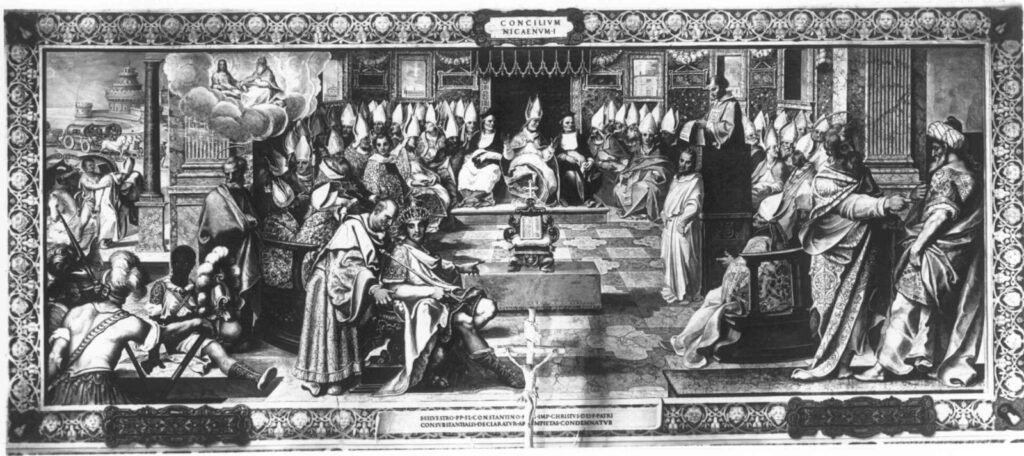
He gave opening speech in Latin, and an interpreter translated it. In the debates he spoke Greek, which he knew a little. He told the bishops that a quarrel inside the church was worse and more dangerous than any war. Eusebius says that he listened patiently to everyone and led the angry bishops step by step to agreement.
Constantine was not bishop, so he did not vote, and Hosius most likely chaired the sessions. The emperor was not even baptized yet. He received baptism shortly before his death in 337, from Eusebius of Nicomedia, the bishop who had supported Arius at Nicaea. At Nicaea he wanted unity in the church, and he wanted it quickly.
At the end of the council the emperor gave a banquet for the twentieth year of his reign. Eusebius says that soldiers stood with drawn swords at doors of the palace, that the bishops walked between them without fear, and that it looked like a dream of Christ’s kingdom. Only a few years earlier, men like Paphnutius had been sent to the mines.
The Creed of 325
A statement of faith was drafted from older creeds, and each line was discussed. Eusebius of Caesarea wrote to his church that he had offered the creed of his own church, and that the council accepted it with some additions. The most important addition was one Greek word, homoousios, which means “of the same substance”.
Some bishops objected to the word. They said that it suggested the Son had been split off from the Father. According to the letter of Eusebius, the Emperor himself explained the word and urged everyone to accept it. So Constantine did not write the creed, but he pressed for its key word.
The creed says: “God from God, light from light, true God from true God, begotten, not made, of one substance with the Father.” Then it says only “And in the Holy Spirit.” At the end come the anathemas, which condemn anyone who says “there was when he was not”.
Almost all the bishops signed. Two, Theonas of Marmarica and Secundus of Ptolemais, refused, and they were exiled with Arius to Illyria. Arius had come to Nicaea too, but he was only a presbyter, not a bishop, and his books were ordered to be burned.
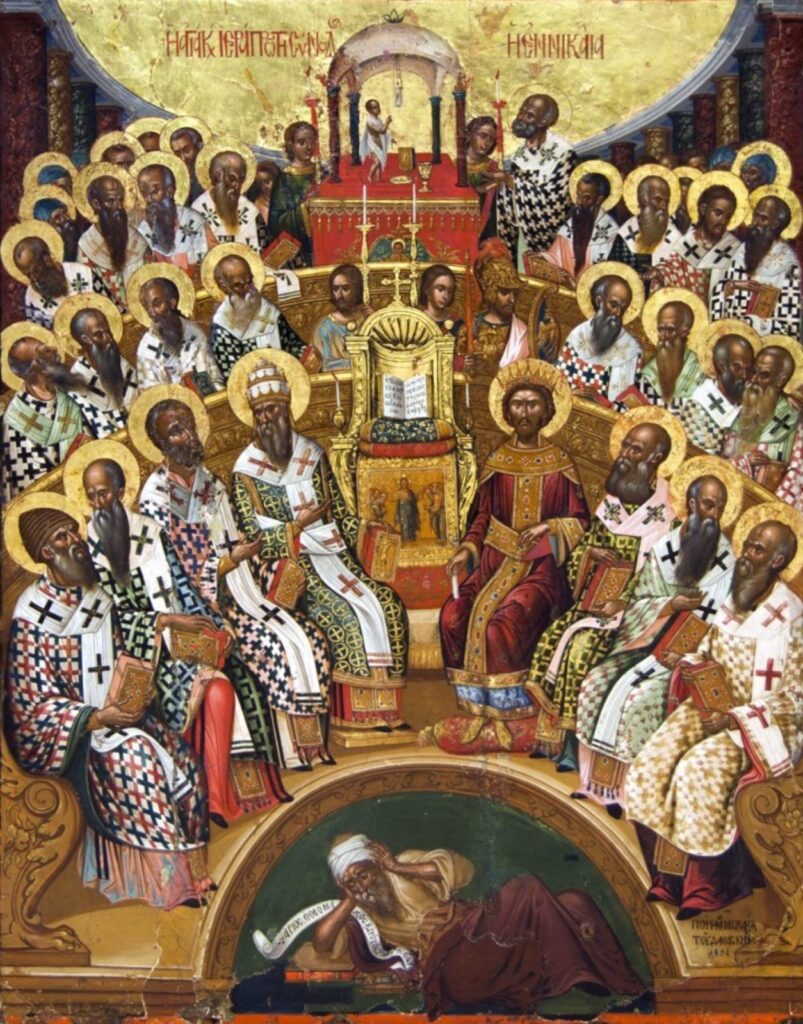
Three more friends of Arius signed only out of respect for the emperor, and Constantine banished two of them, Eusebius of Nicomedia and Theognis of Nicaea, soon afterwards. Eusebius of Caesarea hesitated for a short time and then signed too. Socrates the historian says that the two exiles soon wrote that they accepted the creed.
The creed we recite is not exactly the creed of 325. On most Sundays, churches recite the longer Niceno-Constantinopolitan Creed. Tradition says that the First Council of Constantinople adopted it in 381, and the Council of Chalcedon in 451 is the first to quote it. This longer text is the one most people mean when they say the Nicene Creed.
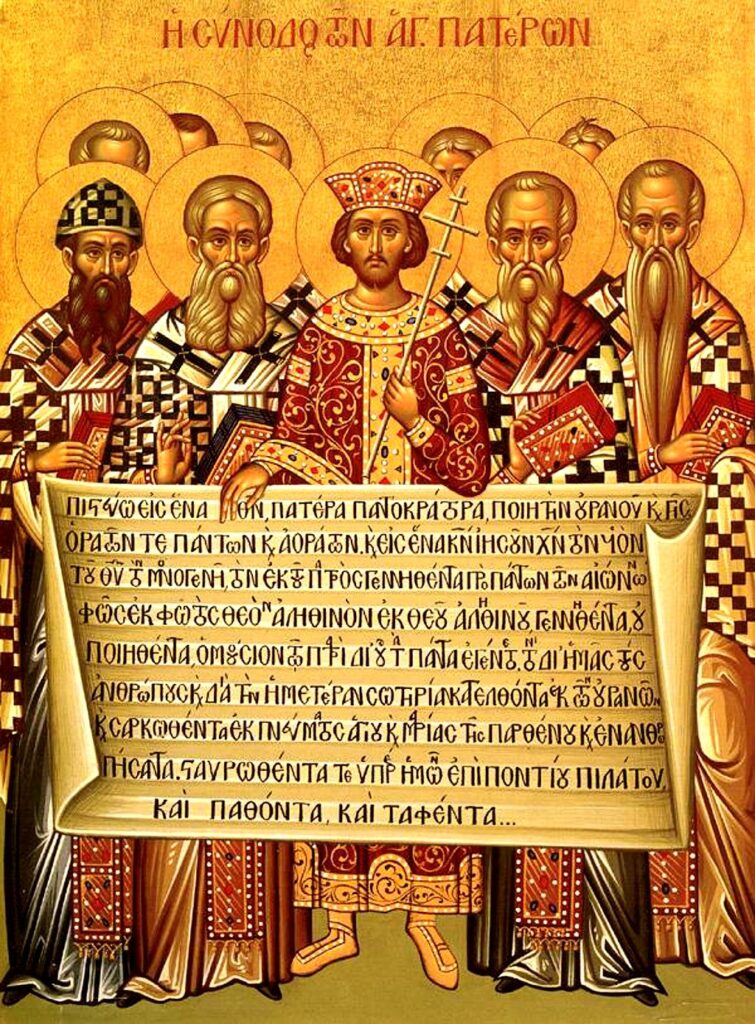
The two texts differ. The creed of 381 says that the Father is “maker of heaven and earth”, it gives the Holy Spirit a much longer line, and it drops the anathemas. The creed of 325 says only “And in the Holy Spirit”. Many scholars think that the creed of 381 grew from another baptismal creed and is not simply an expansion of the creed of Nicaea.
The Date of Easter
The council also dealt with Easter. In the letter the bishops sent to Alexandria, they announce that the brethren in the East who had followed the custom of the Jews would now celebrate Easter together with the Romans and the Alexandrians. Eusebius says that the time of the feast was agreed by all.
The council laid down two rules: Easter must not depend on the Jewish calendar, and it must fall on the same day everywhere. It did not write out the whole method, and working that out took centuries. The familiar rule, the first Sunday after the first full moon after the spring equinox, is usually linked to Nicaea, but its details came later.
This was an old quarrel. In the second century the churches of Asia kept Easter on the 14th of Nisan, whatever the day of the week, while Rome kept a Sunday. Around 154 Saint Polycarp went from Smyrna to Rome to talk about it, and around 190 Polycrates of Ephesus defended the custom of Asia in a famous letter.
By 325 nearly all churches already kept Easter on a Sunday, say many modern scholars. The live question at Nicaea was whether to rely on the Jewish calendar to find the date. Even today the Easters differ in many years, because Catholic and Protestant churches use the Gregorian calendar, and most Orthodox churches use the Julian one.
The Canons and the Meletian Schism
The council issued twenty canons, rules for church life. A few examples show how practical they were:
- Canon 5: the bishops of each province meet in a synod for two times in a year, one before Lent and one in autumn.
- Canon 6: Alexandria keeps its authority over Egypt, Libya and Pentapolis, as Rome has its own custom, and Antioch and the other provinces keep their privileges.
- Canon 11: Christians who gave up the faith without being forced, under Licinius, may return, but only after years of penance.
- Canon 17: clergy may not lend money at interest.
- Canon 20: on Sundays and in the days of Pentecost, prayer is made standing, not kneeling.
The council also had to deal with a split in Egypt. Meletius, the bishop of Lycopolis, had been strict with Christians who gave in during the persecution. After the death of Bishop Peter of Alexandria in 311, he refused to accept the authority of the next bishops and went on ordaining clergy of his own. This is the Meletian schism.
The bishops treated him gently. Meletius could keep his title and stay in his own city, but he lost the right to ordain or to run affairs. The clergy he had ordained received a new laying on of hands and ranked below the clergy of Alexander. The peace did not last, because the Meletians soon joined the Arians and became bitter enemies of Athanasius.
Where the Council of Nicaea Met
The council of 325 met in the imperial palace of Nicaea. Eusebius says that all the members gathered “in the central building of the palace”, which looked larger than the rest, with rows of seats on each side. Nothing of that palace survives, nobody has found its exact place. So no building in İznik is the room where the first creed was agreed.
It is easy to mix up the two councils. The Hagia Sophia of İznik belongs to the Second Council of Nicaea in 787, the seventh and last of the seven ecumenical councils, which restored the veneration of icons. The first council met 462 years earlier, in the palace.
What You Can See in İznik Today
İznik lies in Bursa Province, about 80 kilometers from Bursa and roughly 200 kilometers by road from Istanbul. It is a quiet district town of about 44,000 people, and the old town sits inside its walls. The sights are small and close to each other. I recommend my guests to give İznik at least a full day. April, May and October are the best months.
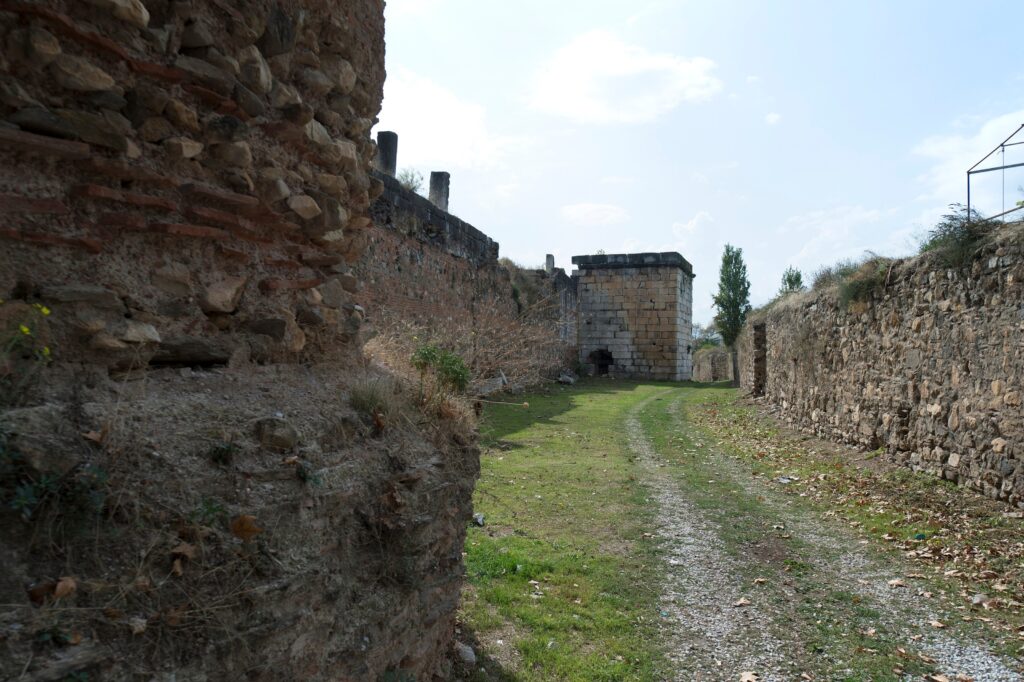
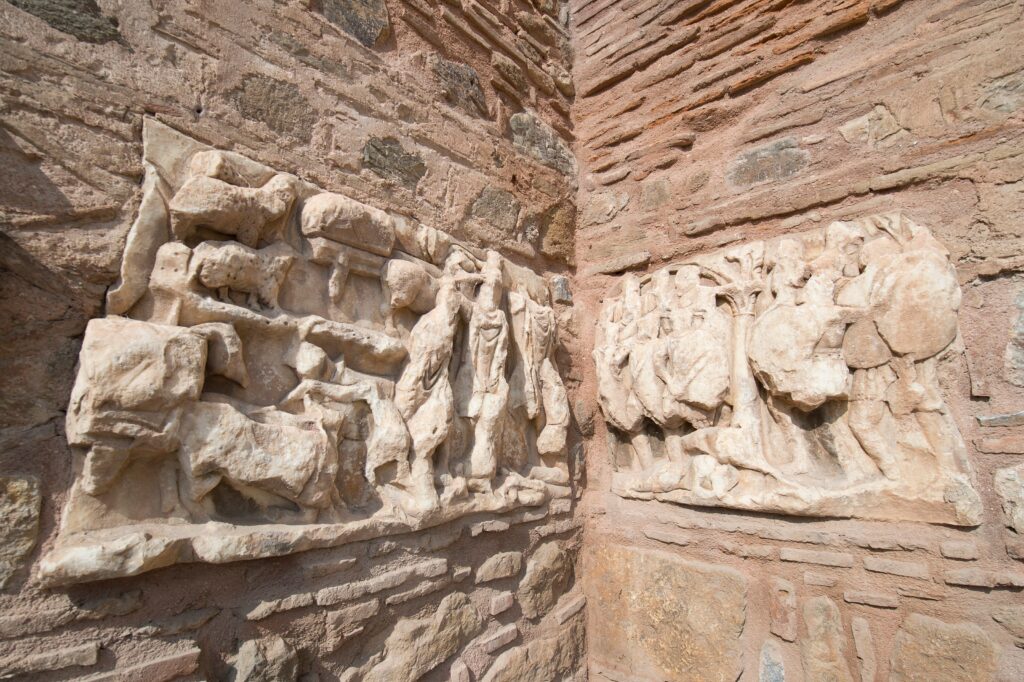
The walls are the first thing to see. They run for about 4,970 meters around the old town, 10 to 13 meters high, with 114 towers, according to the Ministry of Culture and Tourism. The main gates are the İstanbul Gate in the north, the Lefke Gate in the east and the Yenişehir Gate in the south. Nothing is left of the Lake Gate in the west.
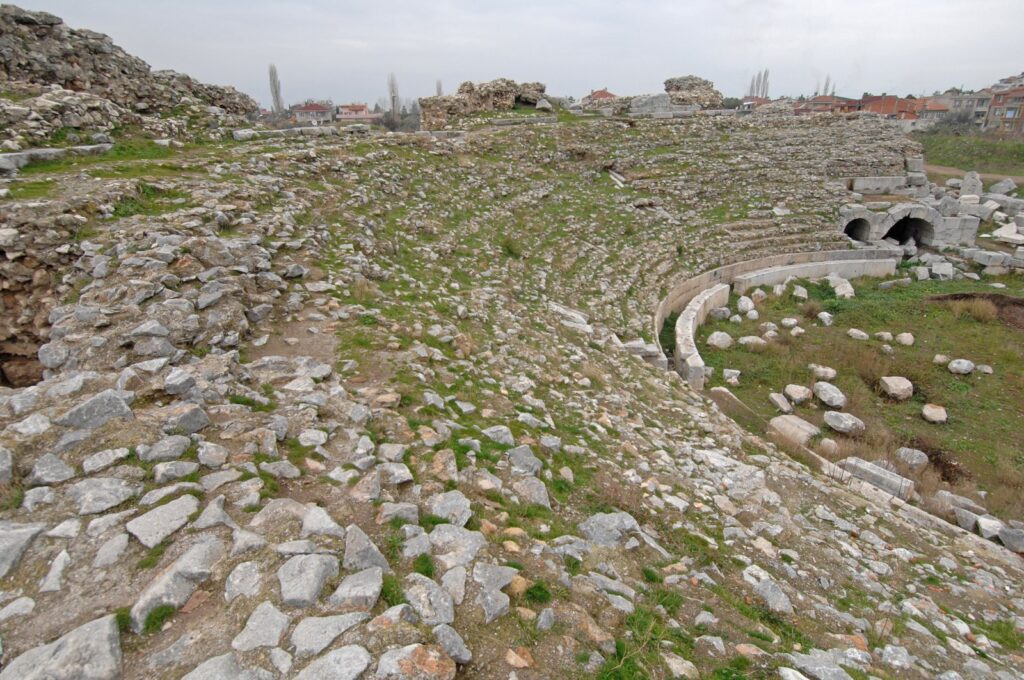
Next is the Roman theater. It stands on flat ground, not on a hillside, and its three levels rested on vaults. It held about 10.000 people. Pliny the Younger, as governor of Bithynia, wrote to Emperor Trajan that the unfinished theater had sunk and cracked and had, he was told, already cost more than ten million sesterces. Turkish archaeologists are still excavating it.
The Hagia Sophia of İznik stands in the middle of the old town. The church of the council of 787 stood in this spot, and the present building was largely rebuilt after an earthquake in 1065. It became the Orhan Mosque after the Ottoman conquest in 1331, a museum in 1935 and a mosque again in 2011.
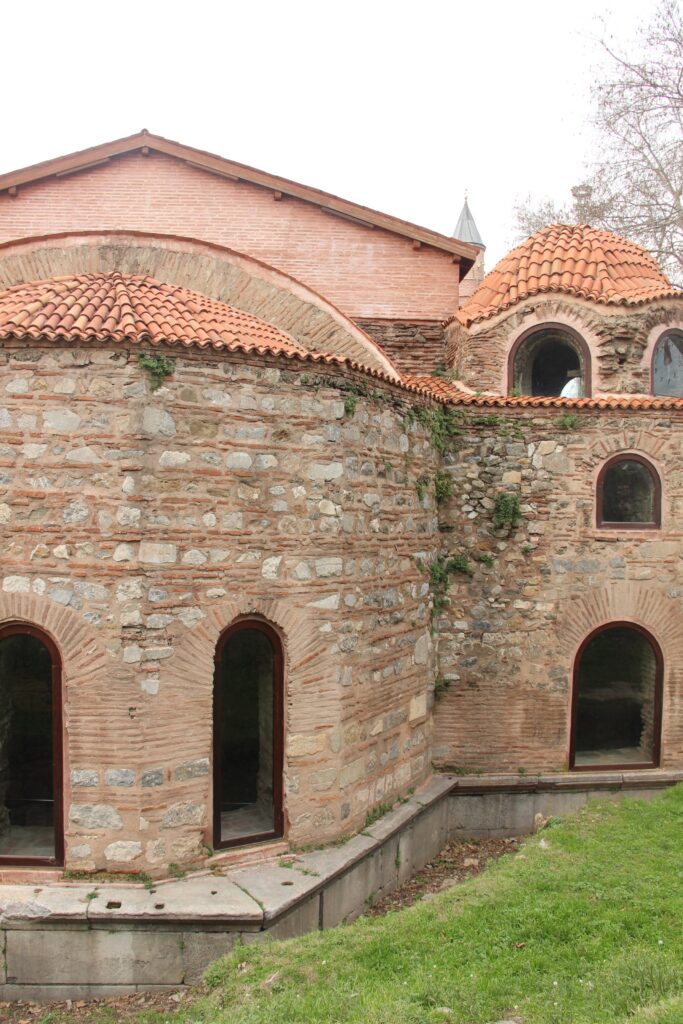
Restorations in the 20th century uncovered pieces of colored floor mosaic and the semicircular seats of the clergy. Look for them inside. Please keep it in mind that this is an active mosque, so dress modestly and check the prayer times. Allow time not just for the walls and the church, also for the lake shore.
The İznik Museum opened in a new building on January 14, 2023. It shows finds from the Neolithic period to the Ottoman era, among them Roman sarcophagi from the area. The old Nilüfer Hatun Imaret keeps the Museum of Turkish and Islamic Works, which is a separate museum.
İznik is also the town of the famous tiles. In the 15th to 17th centuries its workshops made the colorful ceramics and tiles that decorate mosques built by the architect Sinan in Istanbul. Slight traces of the kilns remain. Several modern workshops continue the tradition, and a studio visit is a small pleasure of the trip.
The Lake Basilica and the 1,700th Anniversary
The ruins of the Basilica of Saint Neophytos are laying at the edge of Lake İznik. It was built in the late fourth or early fifth century, where Neophytos, a Christian of Nicaea who died around 303, had been killed on the lake shore. Archaeologists found it in 2014. An earthquake in 740 sank it, but the water has since fallen, and the ruins can be seen at the shore.
Some researchers think the church was built because of the council, though the ancient writers place the sessions in the palace. On Friday, November 28, 2025, Pope Leo XIV and about 27 other Christian leaders, among them Patriarch Bartholomew, who had called them together, held an ecumenical prayer near the excavations for the 1,700th anniversary of the council.
According to Vatican News, the leaders recited the Nicene-Constantinopolitan Creed together, and the pope called their shared faith “a profound bond already uniting all Christians”. It is the text from 381, not the creed of 325, but the bishops who met here in 325 started it all.
After the Council
The council did not end the quarrel. Constantine slowly softened toward the exiles, and after Alexander died, Athanasius became bishop of Alexandria. In 335 a synod at Tyre deposed Athanasius. Arius came back to Constantinople in 336 to be received into the church, but he died shortly before it could happen, and Constantine died in 337.
Two later emperors in the East, Constantius II and Valens, favored the Arian side, and the fight went on for decades. Saint Jerome described the council of Rimini in 359 with the words: “The whole world groaned, and was astonished to find itself Arian.”
The matter was settled in 381, when Emperor Theodosius I called the First Council of Constantinople, one year after he made Nicene Christianity the faith of the empire, as I describe in my article on how Asia Minor turned from pagan to Christian. In 431 the Council of Ephesus confirmed the creed of Nicaea again and used it against Nestorius.
Why Nicaea Still Matters
The council was not perfect. The bishops did not always behave well, the emperor’s pressure was real, and the quarrel went on for another fifty years. Still, the words they wrote in this lakeside town are recited in churches all over the world.
When you stand on the walls of İznik and look out toward the lake, you are close to the place where it began. The lake has changed little, the walls are still there. The town has been Christian and Muslim, rich and quiet. The words written in Nicaea went out from this town and traveled.
Frequently Asked Questions
Who attended the Council of Nicaea?
About 250 to 318 bishops came, most of them from the eastern half of the empire, with priests and deacons. Hosius of Cordoba, Alexander of Alexandria with his assistant Athanasius, and Eusebius of Caesarea were there, and Pope Sylvester sent two priests. Arius attended as a presbyter, and Emperor Constantine opened the council and took part in the debates.
Was Arius at the Council of Nicaea?
Yes, but he was a presbyter, not a bishop. The council condemned his teaching, and Constantine exiled him to Illyria. Later the emperor allowed him to return. Arius went to Constantinople to be received back into the church, but he died there in 336 before it could happen.
What did the Council of Nicaea decide about Easter?
It decided that Easter must not depend on the Jewish calendar and must be celebrated on the same day by all churches. The details of the calculation were not written down at Nicaea and were worked out later. Catholic and Protestant churches now use the Gregorian calendar and most Orthodox churches the Julian one, so the dates often differ.
What is the difference between the Nicene Creed of 325 and 381?
The creed of 325 ended with a short line about the Holy Spirit and with anathemas against the teaching of Arius. The creed of 381, used in most churches today, is longer. It says more about the Holy Spirit, calls the Father “maker of heaven and earth” and has no anathemas.
Hire Biblical Tour Guide in Turkey
I’m a nationally licensed Turkish tour guide based in Kuşadası, nearby Ephesus. My day guiding is in Ephesus, İzmir and Pamukkale, so İznik is outside my day guiding. My license is valid all over Turkey, so I can join you in İznik as your personal guide on a longer journey, while you arrange your transport and hotels yourself or through a licensed travel agency.
See my guiding rates and guiding areas or write to me through my contact page. For a wider plan, read my guide to Christian Turkey for first-time visitors and my list of sacred attractions and routes in Turkey, which has İznik too.
I hope we will stand together on the walls of İznik, with the lake behind us. You can always write to me with your questions about the Council of Nicaea. See you soon, Hasan Gülday.