Ephesus vs Pergamon is a comparison of two capitals of Roman Asia at their peak eras. Pergamon peaked as the royal city of the Attalid kings in the 3rd and 2nd centuries BC, with a second bloom under Rome in the 2nd century AD. It sits on a steep hill above the Caicus plain. Ephesus peaked as the Roman harbor capital of the province of Asia in the 1st and 2nd centuries AD.
Add Tours Around Turkey as a preferred source on Google
My guests often ask me which of the two they should see, since both are in the Bible. I tell them that they are very different cities, and each one is the best at something. Let’s have a look at them, each at its best time.
Ephesus vs Pergamon at a Glance
Here are the two cities in short.
| Topic | Ephesus | Pergamon |
|---|---|---|
| Peak era compared | Roman Imperial, 1st to 2nd century AD | Attalid, 3rd to 2nd century BC; Roman, 2nd century AD |
| Town today | Selçuk, İzmir Province | Bergama, İzmir Province |
| Setting | Harbor city on the Cayster | Hilltop city above the Caicus |
| Type of city | Roman provincial capital | Royal capital of a Greek kingdom |
| Most famous ruin | Library of Celsus | Steep hillside theater |
| Lost wonder | Temple of Artemis | Great Altar |
| Church of Revelation | First letter | Third letter |
| UNESCO list | 2015 | 2014 |
Setting and Rulers at Their Peak
Pergamon was built on a rocky hill that rises about 335 meters above sea level, on the north side of the Caicus plain, today’s Bakırçay valley. The sea is about 26 kilometers away. Its buildings climbed the hill in terraces, and the town of Bergama grew at its foot. More in my article on Pergamon Ancient City.
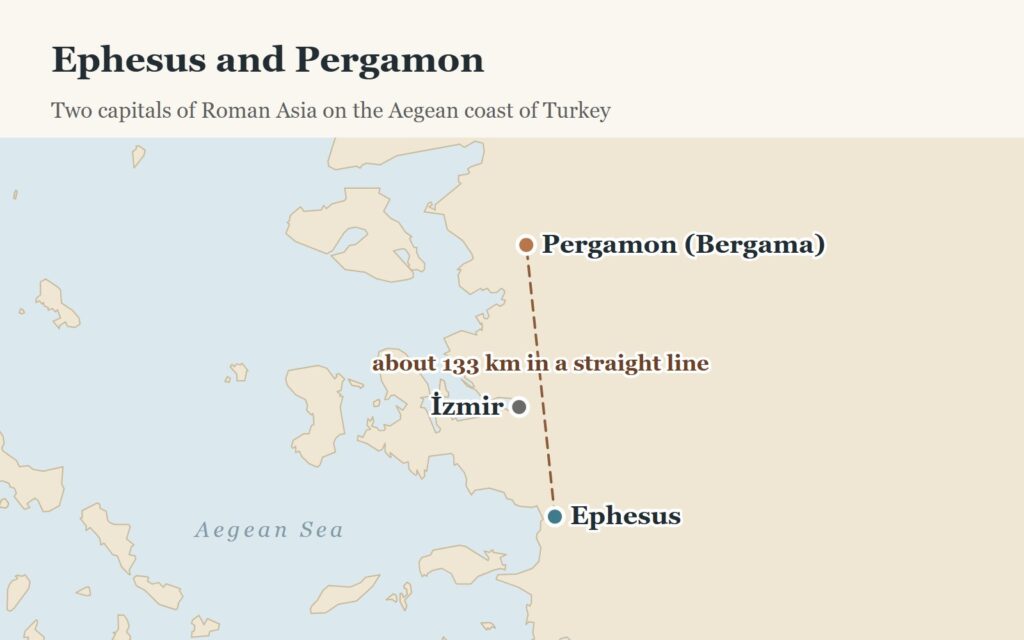
Ephesus was the opposite: a city built for ships. It stood at the mouth of the Cayster river, the Küçük Menderes, and its harbor was the door of whole province. The river slowly filled that harbor with silt, and today the ruins lie about 5 kilometers inland. The two cities are about 133 kilometers apart in a straight line.
Pergamon’s golden age began with Philetaerus, who founded the Attalid dynasty in 281 BC. Eumenes II, king from 197 to 159 BC, gave the city its great monuments. In 133 BC Attalus III died without an heir and left his kingdom to Rome in his will. His lands became the core of the Roman province of Asia.
Pergamon was first seat of the new province, but only for a short time. It is believed that by the time of Emperor Augustus, Ephesus had become the capital, and the Roman Governor lived there. Ephesus had a new start earlier too: Lysimachus moved the city to its present place in the early 3rd century BC. Under Rome, governors and rich families covered it in marble.
Both cities wanted the honor of “neokoros”, the keeper of a temple for the emperors. Pergamon was first, with a temple for Rome and Augustus. Ephesus received its own under Domitian, and in the 2nd century both cities collected more titles. Read the Ephesus side in Temple of Domitian in Ephesus.
Libraries, Theaters and Temples
The library of the Attalid kings was the second largest of the Greek world, after Alexandria. It is said that it held about 200,000 scrolls, and it is said that Mark Antony later gave them to Cleopatra. Our word “parchment” comes from the name of the city, because Pergamon was famous for writing material made from animal skins.
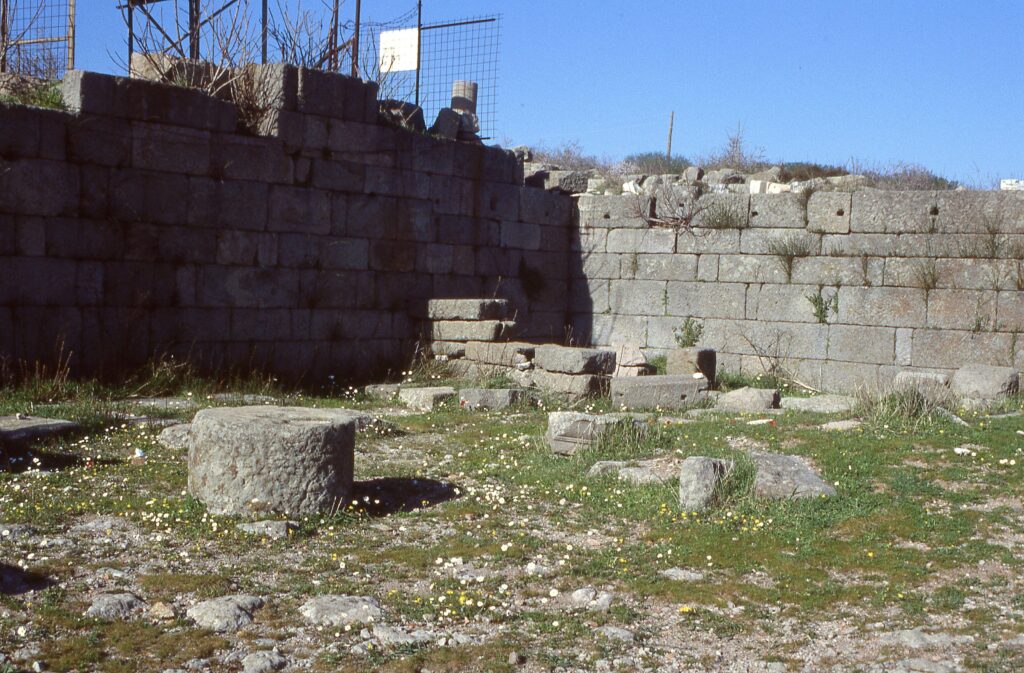
The Library of Celsus in Ephesus is younger and smaller, but you can still stand in front of its two-story facade. A son built it for his father, the governor Celsus, and it was finished in the first half of the 2nd century AD. It may have held about 12,000 scrolls, and Celsus himself is buried under it.
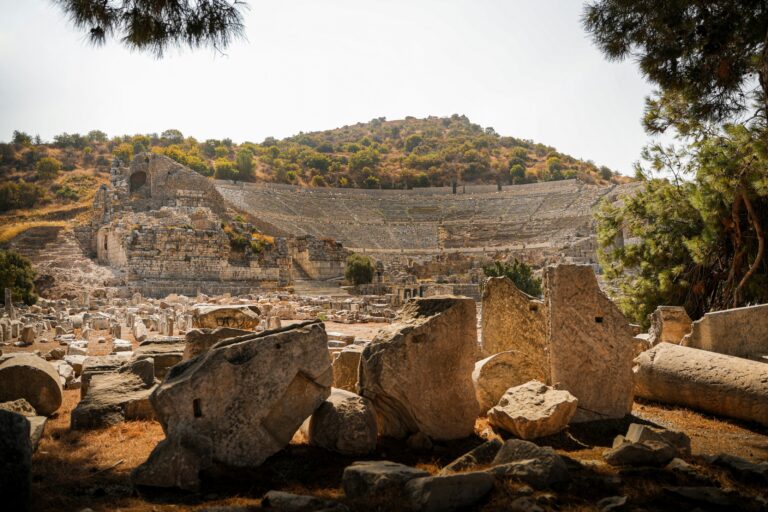
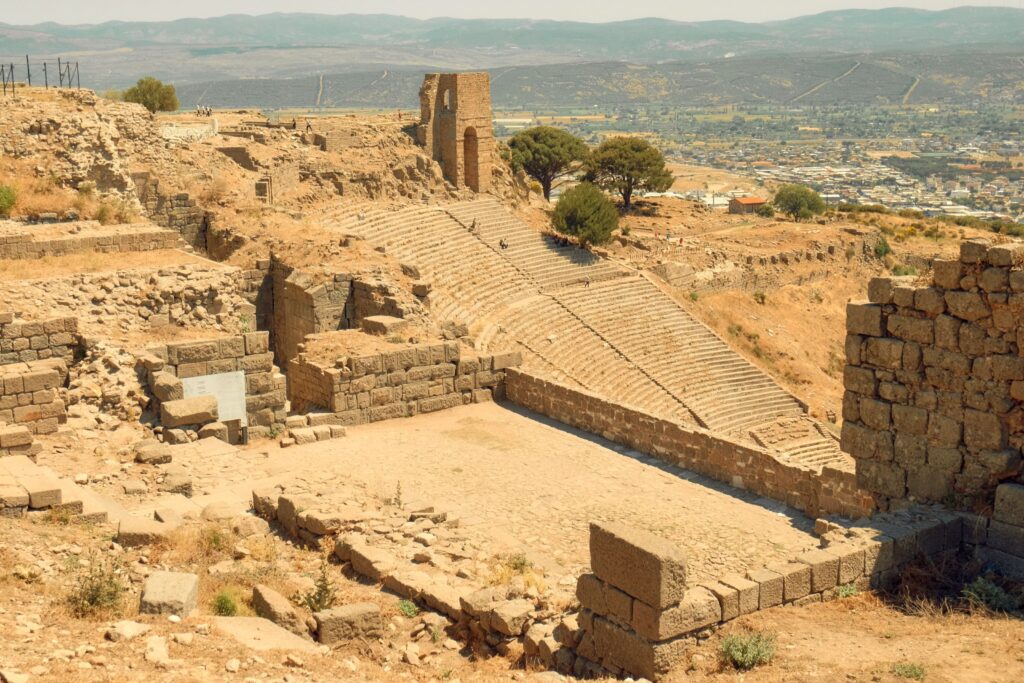
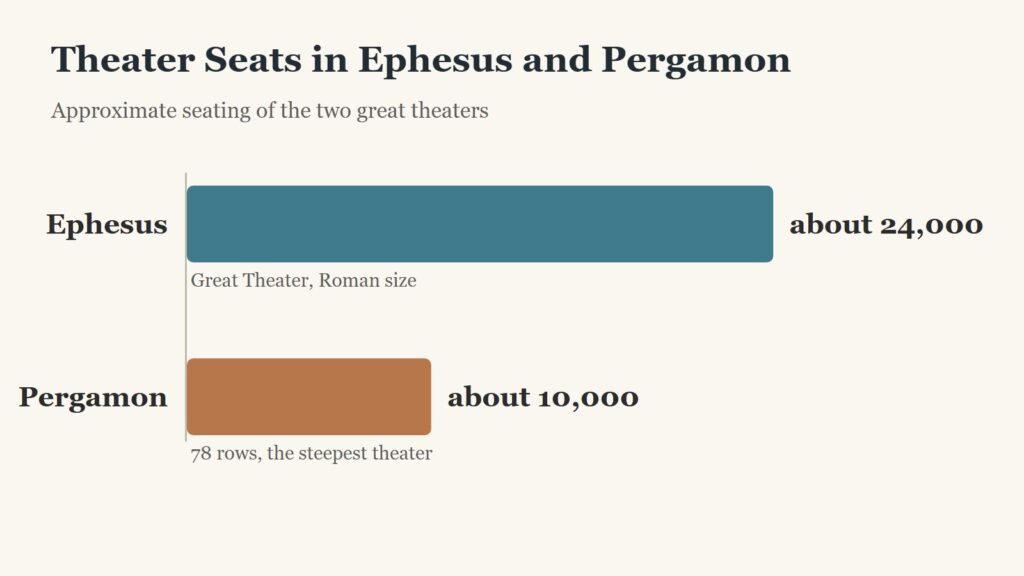
Theaters show the two settings best. In Pergamon the seats drop down the hillside in 78 rows for about 10,000 people, and it is one of the steepest theaters of the ancient world. The Great Theater of Ephesus held about 24,000 people. There the crowd shouted “Great is Diana of the Ephesians” (Acts 19:28), as I tell in my article on the Great Theater of Ephesus.
Each city also had a wonder. Ephesus had the Temple of Artemis, one of the Seven Wonders of the Ancient World. Pergamon had the Great Altar, carved all around with the battle of the gods and the giants. Its foundation is still on the hill, and its frieze is kept today in the Pergamon Museum in Berlin. On the very top of the hill stands the Temple of Trajan from the Roman bloom.
Doctors and Water
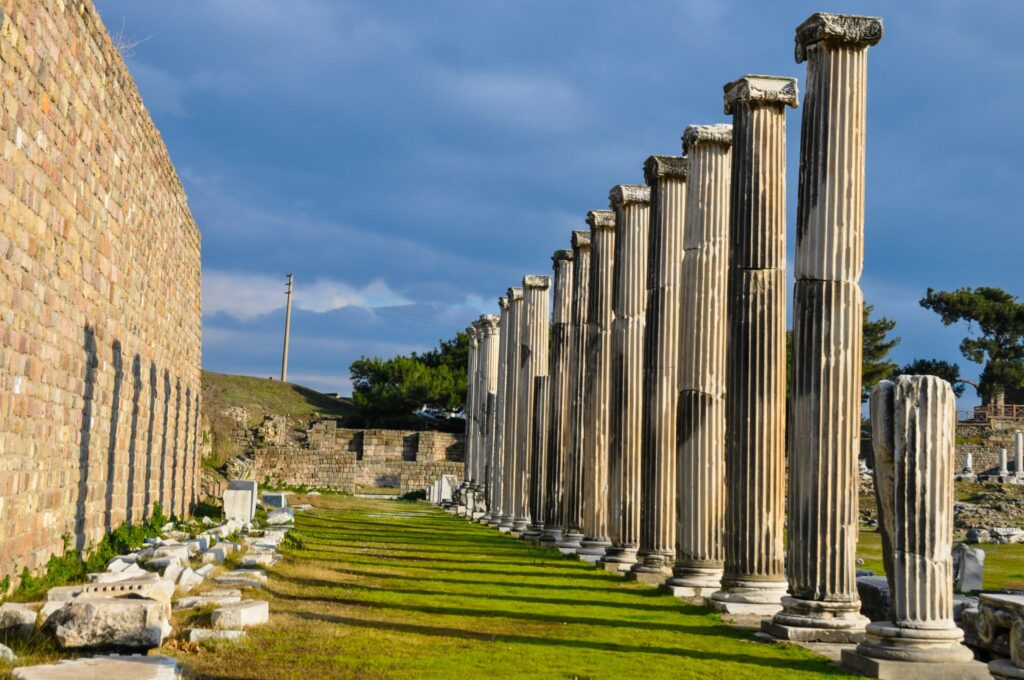
Pergamon was the city of healing. Its Asklepieion, the sanctuary of the healing god Asclepius, was reached by a sacred way with columns about 820 meters long. Galen was born in Pergamon around AD 129, trained there and later became the doctor of Emperor Marcus Aurelius. You can read his story in Galen the Greatest Doctor of Antiquity.
Ephesus also had famous doctors too. Rufus of Ephesus wrote on the human body and on how to question a patient, and Soranus of Ephesus became known for his work on women and childbirth. Read more in Rufus the Doctor from Ephesus. By the way, in Turkish we still say “hekim” for a doctor, as in “diş hekimi”, the dentist.
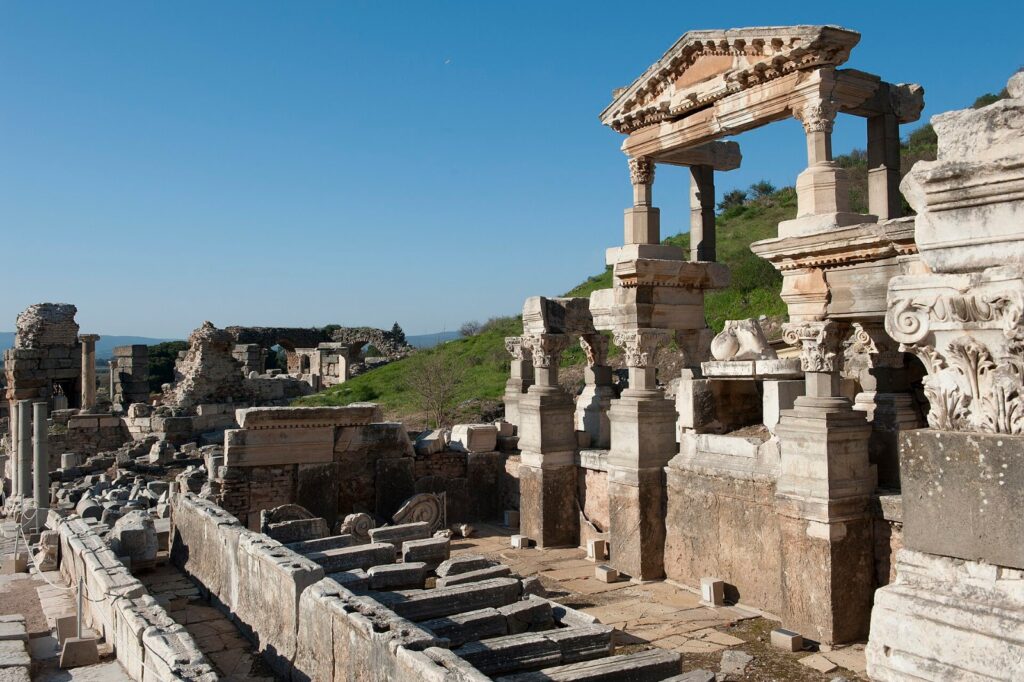
Water was a challenge on the hill, engineers brought water from the Madradağ mountains more than 40 kilometers away. For the last part they used a lead pipe under high pressure, which carried water down into a valley about 200 meters deep and up again onto the acropolis. Ephesus had several aqueducts. One was built by Gaius Sextilius Pollio, and others fed fountains like the Fountain of Trajan.
Here are the peak-era points side by side.
| At its peak | Ephesus | Pergamon |
|---|---|---|
| Key rulers | Lysimachus, then Roman governors | Philetaerus, Eumenes II, Attalus III |
| Capital of Asia | Yes, from about the time of Augustus | First seat, for a short time |
| Library | Celsus, about 12,000 scrolls | Said to hold about 200,000 scrolls |
| Theater | About 24,000 seats | About 10,000 seats, 78 rows |
| Great monument | Temple of Artemis | Great Altar |
| Medicine | Rufus and Soranus | Asklepieion and Galen |
| Water | Several aqueducts | Pressure pipe from 40+ km away |
| Emperor temples | First under Domitian | First in Asia, Rome and Augustus |
Ephesus and Pergamon in the Bible
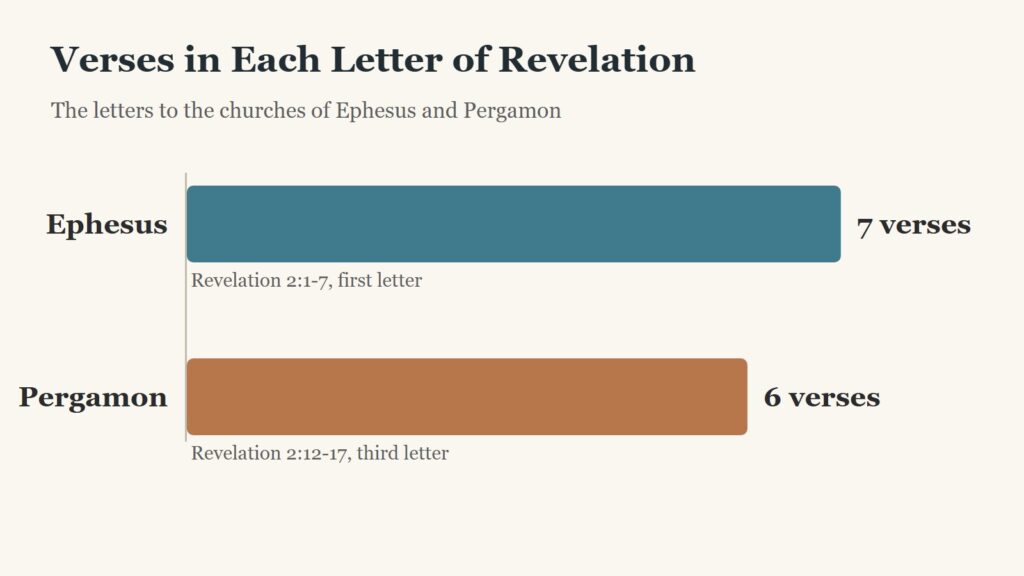
Both cities are among the seven churches of Revelation. Ephesus received the first letter (Revelation 2:1-7) and Pergamon the third (Revelation 2:12-17). The letter to Pergamon names Antipas, “my faithful martyr”, and says the church dwells “where Satan’s seat is” (Revelation 2:13). I tell more in the letter to Pergamon and the church of Pergamon.
Ephesus has the longer Bible story. Paul taught three months in the synagogue and two years in the school of Tyrannus (Acts 19:8-10), and he says he was there three years (Acts 20:31). Acts tells of no visit by Paul to Pergamon. I also compared Corinth vs Ephesus.
Visiting Ephesus and Pergamon Today
In Pergamon I like to take the cable car up to the acropolis, so we save our legs for the theater steps. On the top you see the Temple of Trajan, the foundation of the Great Altar and the theater with the whole plain below. Then we drive down to the Red Basilica in Bergama town and to the Asklepieion.
In Ephesus, most visits start at the Upper Gate and walk downhill on the marble streets, past Curetes Street to the Library of Celsus and the Great Theater. My article on the Upper Gate or Lower Gate of Ephesus explains the two entrances.
| Visiting today | Ephesus | Pergamon |
|---|---|---|
| Nearest town | Selçuk | Bergama |
| How the visit flows | Downhill walk from the Upper Gate | Cable car up, then sites in town and below |
| Top sights | Curetes Street, Library of Celsus, Great Theater | Acropolis, theater, Red Basilica, Asklepieion |
| Lost wonder today | One rebuilt column of the Artemis temple | Altar foundation on the hill, frieze in Berlin |
The road between them goes through İzmir. The drive takes about 2.5 hours from Ephesus, and about 1.5 hours from İzmir to Pergamon. I hope you can give each city its own day, because both deserve a slow walk.
Frequently Asked Questions
Which is better to visit, Ephesus or Pergamon?
Both are worth it. Ephesus gives you a whole Roman city on one long walk, and Pergamon gives you a royal hill with wide views, a very steep theater and a healing sanctuary. If you have time for only one, I usually suggest Ephesus for a first visit to this coast.
What is the distance between Ephesus and Pergamon?
About 133 kilometers (about 83 miles) in a straight line. By road, through İzmir, the drive takes about 2.5 hours. From İzmir to Pergamon it is about 1.5 hours.
Can you see Ephesus and Pergamon in one day?
It is possible from İzmir, but it is a long day with many hours on the road and little time at each site. Two days, one for each city, is much more relaxed.
Hire Ephesus Tour Guide

I am a nationally licensed Turkish tour guide based in Kuşadası, nearby Ephesus. My day guiding is in Ephesus, İzmir and Pamukkale, and my national license lets me guide in Pergamon too, or join you as your personal guide in other regions of Turkey on a longer journey.
You can see my guiding rates and guiding areas, or write to me through my contact page to ask about my availability.
I hope we will climb the theater of Pergamon and walk down Curetes Street together one day. Write to me with your questions about these two old capitals. See you soon, Hasan Gülday.